
For richer or poorer, our lives are influenced not only by whom we marry, but also by the physical objects we live with every day.
The QWERTY keyboard, for example, which nearly all of us type on (including me at this very moment), is the result of an unfortunate standard adopted more than a century ago for mechanical typewriters. Its goal had nothing to do with helping typists but was created originally for Morse code operators, in order to minimize collisions between the slender mechanical arms, each with its own letter, as they flew up and whacked the ribbon against the paper.
QWERTY is not in the least ergonomic, having been set before that word was even in the dictionary. Better keyboard layouts were devised, but alas, they came too late. Even in the 1930s, there were already too many typists who had paid their dues learning how to touch-type (versus hunt & peck) on QWERTY keyboards who weren’t willing to start over again with a new layout. All future generations have been poorer because of it, although we also have stronger pinky fingers.
 The unfortunate QWERTY layout continues its awkward imprint on our keyboards today.
For a more recent example, take charger cords and their evolving connectors. USB stands for—I just looked this up—Universal Serial Bus. (Nothing to do with the bus we ride; it’s computerese for shared pathway.) Except that we have USB-A, mini-USB, micro-USB and lately, USB-C, a hodgepodge that hardly suggests “universal.” On the positive side, thanks to not-so-universal USBs, we all got to learn the related term “dongle,” meaning a plug-in device for your computer that can function like digital duct tape.

In contrast to these ill-starred standards, I’m happy to report that both pen and paper refills enjoy nearly universal standards. We’ve designed Levenger pens and paper using these standards, to make our products as hassle-free as possible for our customers.
Open refills versus captive refills
All Levenger fountain pens take standard universal cartridges, which benefit customers in two ways. First, you can use Levenger ink cartridges in many other fountain pens. Second, you can buy standard ink cartridges made by other brands and use them in your Levenger fountain pens.

Levenger standard ink cartridges fit in many other pens as well.
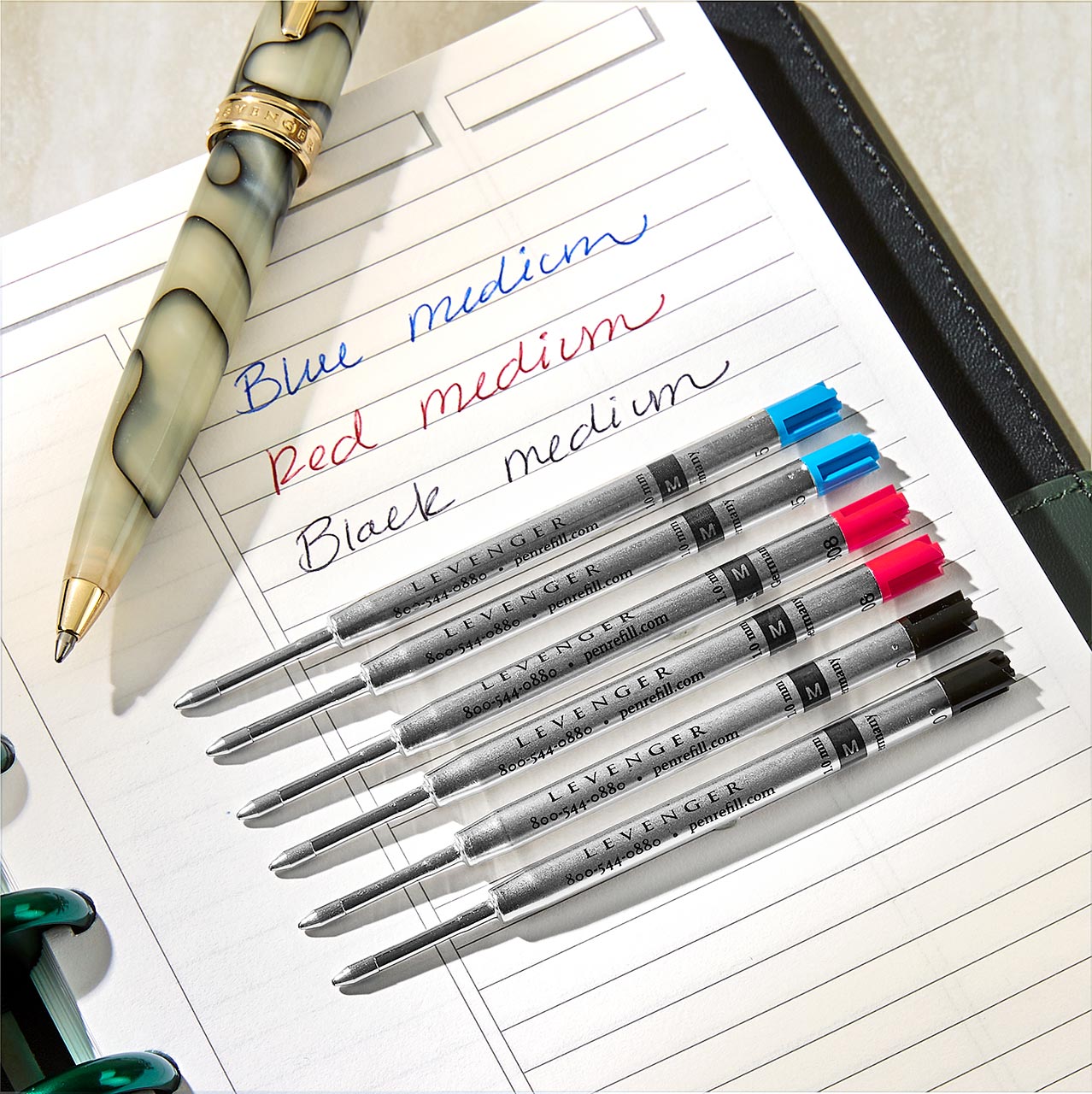
Buy a Levenger ballpoint pen and you’ll enjoy this same freedom, since we use Parker universal-style refills. These are the ingenious rotating refills that Parker invented back in the 1950s for its famous Jotter. With its original patent long expired, many ballpoint refill makers have adopted the Parker standard. To refill Levenger ballpoint pens, you can use our sehr gut German-made Levenger ballpoint refills or any readily available Parker style refills sold around the world. And you don’t even need to know that sehr gut means very good.

Levenger ballpoint refills abide by the Parker universal standard—compatible with many pens.
Enjoy even more refill freedom with our rollerball pens. Customers love our colorful True Writer rollerballs and Engineer Pens loaded up with our Levenger refills, but (insider tip) if you want even more color and point-size options, load Pilot G2 gel ink refills into any Levenger rollerball. Japan’s Pilot G2 pens are probably the most popular and easy-to-find gel ink pens on the planet and they write great.

Levenger rollerball refills fit in many other brand pens as well. Pilot G2 gel refills will fit in Levenger rollerballs—the benefit of standardization.
Not all pen manufacturers grant their customers such freedom. If, for example, you buy a Montblanc ballpoint or rollerball, you can load only Montblanc refills in them.
Celebrating the 150th birthday of the index card
At Levenger, we sell many different styles of leather holders for cards. We call them our Pocket Briefcases and have been selling them for more than 25 years. Despite the ubiquity of smartphones—and the dearth of briefcases—many people still enjoy the peace of paper and carry this handy, heritage technology.

The Levenger Pocket Briefcase adopts, and celebrates, the venerable 3 x 5 index card.
We could have used any number of different sizes for our cards, but we chose the standard 3 x 5 index card size for everyone’s convenience. While we recommend the durable, high-quality card stock, the variety of formats, and the personalization our 3 x 5 cards offer, we respect the fact that you may want to buy cards at local retailers. They will fit in our Pocket Briefcases, thanks to that handy standard size.
Those over the age of 50 might remember rows of card catalogs in libraries. Next year will mark 150 years since the American Library Association officially adopted the 3 x 5-inch “index” card as the standard for library filing systems. Before computers took over, the Library of Congress boasted of having more than 12 million such cards describing its holdings.
And what a useful standard the humble 3x5 still is. The cards are small enough to be easily pocketable, while also being large enough to hold an impressive amount of information. How many millions of such cards have helped students learn math, science, French, and so many other subjects. Their power lies not only in having them, but in writing them by hand with pen or pencil, and thus benefiting from the kinesthetic boost to memory that writing by hand delivers.
Writing pads that inspire their users
While writing pads come in many different sizes, we chose to adopt the standard letter-size pad for our popular Freeleaf Pads. You can put any of the wide variety of Freeleaf pads in Levenger leather folios, or into other folios that take this standard American format.

While the size of Levenger letter pads are standard, the designs are anything but.
Our Oasis Pads are exactly double the width of standard letter-size pads, so you can fold Oasis sheets in half for easy filing. Our refillable Stanley Journal also adopts the standard 5-½ by 7-¾ journal format.
And now, Levenger sets a standard for others
Soon after World War II, a couple of brilliant Belgium inventors figured out how to make a better notebook. Instead of binding pages together permanently with glue, staples or wire, they took advantage of the natural property of paper—to be flexible when in individual sheets, yet strong when kept together. They devised plastic free-floating discs, thin in the center and mushrooming out at the perimeter. These glided along the edge of the notebook, allowing individual sheets to be pressed in or peeled out of the notebook, while the rest of the notebook remained strong. It was a design breakthrough.
But such notebooks were inherently more expensive to produce and, being more expensive for consumers, failed to supplant the inferior but cheaper notebooks people were used to. Thus disc notebooks floundered for decades.
Levenger was the first company to look upon these inherently better, little-known notebooks and ask not “How can they be made more inexpensively to compete with conventional notebooks?” but “How cool could paper notebooks become? How could they be made not only functionally better, but beautiful beyond past precedent?” This led to higher paper quality, beautiful leather covers, and discs not just of black plastic but of colorful resins and anodized aluminum.

Levenger designers asked, “How cool could paper notebooks become?”
Thus was born Levenger Circa notebooks with smooth, satisfying paper, full-grain leather covers, and ultra-smooth and colorful discs. They were so successful, despite their higher prices, that other companies copied Levenger notebooks, not only in their appearance and page layouts, but also, importantly, using the Levenger standards for disc spacing and size.
At first we were angry about the shameless copying by our competitors, but then we realized that all these companies that had copied the Levenger standard were doing a good thing for customers. Just as with our pens, our customers were free to substitute compatible paper they purchased from office-supply stores. Conversely, other customers who started with the cheaper versions of disc notebooks might discover Levenger and upgrade.
This is how commerce is supposed to work: businesses compete by making both better products and cheaper products to satisfy a growing range of customer needs and desires.
When proprietary helps set the standard for standards
There can be legitimate reasons to require customers to buy original, branded refills. US patent law is designed to protect both innovation and the public good by balancing interests. Inventors get their years in the sun, protected from copycats, in exchange for making their inventions public. After a fixed number of years, other companies are free to make copies, often selling them for less. From generic drugs to standard ballpoint pen cartridges, entrepreneurs and customers have gained by following this well-conceived rule of law. Thus today’s standard light bulb uses an Edison E26 base, and we buy standard Phillips screws anywhere, more than a century after the original patents have expired.

Once patent-protected, the Phillips screw and the Edison lightbulb standards are
now open to all.
But companies that cook up proprietary refills not for innovation but for entrapment violate the Golden Rule. Fortunately, Levenger customers can purchase Levenger pens and paper knowing they have the freedom to buy refills from many other companies besides Levenger. It gives us the proper incentive to keep making ours better! Like a good marriage, good product development depends on renewal.

Steve Leveen
Levenger Co-Founder