
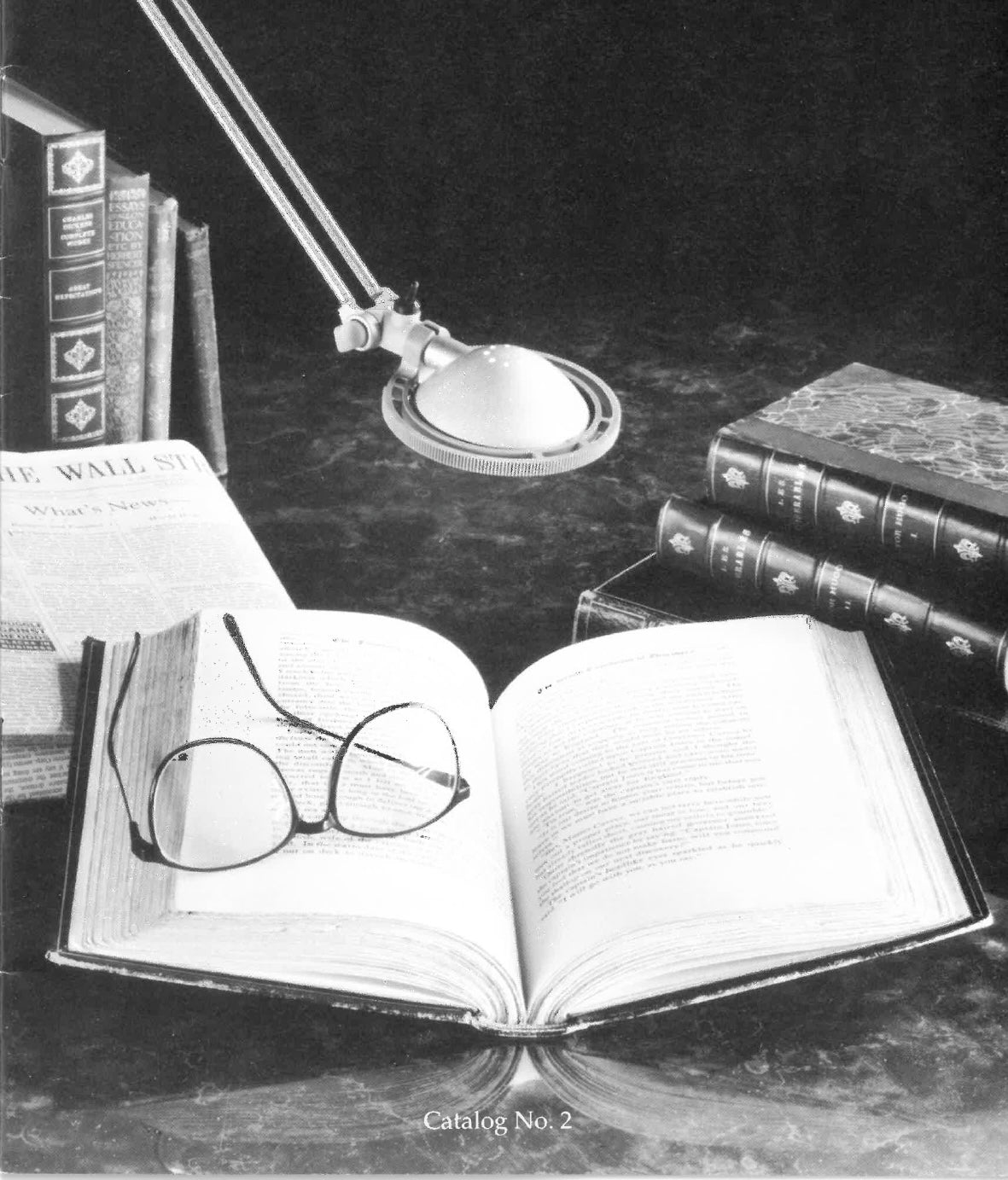
While most of us read on digital devices at least some of the time, paper books have proved surprisingly tenacious in keeping their grip on our reading lives, and for good reason. Their heritage technology delivers satisfying, physical pleasures that are absent in cold screens. But now that paper books face such keen competition from devices that produce their own light, it’s even more important to make sure we light our analog pages properly.
First light at Levenger: reading lamps
When Lori and I founded Levenger back in 1987, our first product was a bedside reading lamp made by a Swedish company called Sunnex. The funny thing was, that light wasn’t designed for bedside reading but rather, for helping technicians assemble electronic circuit boards and perform other such close work. The lamp featured a low-voltage halogen bulb inside a black fluted, hard-rubber shade about the size of a mug of coffee, and about as warm. By coincidence, this industrial-looking, focused light produced just the kind of light needed while reading in bed–especially if the reader’s partner wanted to sleep.
 An original Sunnex, with its 20-watt low-voltage halogen bulb, serves me well in my shop.
The lamp, which we christened Midnight Reader, was unlike other lamps at the time. Back in the 1980s, most lamps offered for sale to the home market emphasized appearances. Did the color of the shade match the decor? Was the style of the base right? It was all about form, not function. So our fledgling company was able to find a niche selling functional lighting for people who were serious about their reading. Our first tiny ad in the back pages of The New Yorker magazine advertised “Serious Lighting for Serious Readers,” and offered a free catalog (really, just one black-and-white sheet of paper folded twice).

Form now follows function, fashionably
Low-voltage halogen lamps were the new thing in 1987. Their novelty provided part of the wind in the sails of our infant company. Those lamps offered focused, intense light without the need for thick, 120-volt wires, but only 12-volt connections (think model trains). Thus industrial designers were freed to go in radically new directions, most iconically realized in the lamp that Richard Sapper designed called the Tizio, which Levenger also sold. The lamp is now in the collection of the Museum of Modern Art.

Sapper’s Tizio took brilliant advantage of low-voltage technology by passing the electricity through the frame of the fixture itself, which merely snapped together.
Hundreds of New Yorker readers did request our free catalog and then–and this is why New Yorker readers will always be beloved by us–ordered, sending us checks in the mail. We felt such a keen obligation to these trusting customers that I said to Lori, “Well, now we sure as hell better learn something about lighting for serious readers because these intelligent, discriminating New Yorker readers expect us to know something.” That’s when I sent myself to lighting school.
Learning the lighting ropes
The trouble was, lighting school didn’t exist. Fortunately, before becoming a fledgling merchant, I had been a science journalist, so I figured I could learn the science of lighting by talking to lighting scientists. Turns out lighting scientists didn’t exist either, but what did exist, and still do, are lighting engineers. So those are the experts I sought out and sat down with in their cubicles inside of companies like Osram, Sylvania, and GE. I think it was likely a novel experience for these engineers to have a sales and marketing guy, which is what I was, want to sit down with them to learn something. That’s maybe why they were so patient with me.
The first thing I learned was some insider vocabulary. What most of us call light bulbs, lighting engineers call lamps. And what most of us call lamps, lighting engineers call fixtures. That sorted, things can get complicated fast.
Lamps emit lumens. The light that actually hits your page is measured in footcandles or, if you prefer metric units, lux. What most of us would describe as warm light or white light, engineers describe, quantitatively, as color temperature. For example, warm candle light is around 1800 K (kelvin), whereas the white halogen light of our read-in-bed light would be around 3000 K.
The light output of any fixture can be measured, and those measurements are called its photometrics. You can think of a fixture’s photometrics as its light fingerprint.
Knowing some of the physics of lighting helped us select better fixtures for our customers. Beyond that, I learned some simple tips from those kind lighting engineers that are of practical, and enduring, value to readers.
This knowledge can be important because some people set themselves up in exactly the wrong way with their lighting. This can cause general discomfort that can shorten our reading and writing sessions. In severe cases, it can cause headaches. Sometimes readers may not even be aware of how they are handicapping their own productivity.
Knowing a few things about how to get your lighting working for you rather than against you will deliver a more rewarding reading life. In that spirit, here are five simple tips that may help you and your loved ones.
#1. When to enjoy the view, and when not to
If you’re lucky enough to have a room with a view, the natural temptation is to position yourself to be able to enjoy that view when you look up from your book or papers. Trouble is, that’s often exactly the wrong thing to do.
During the day, light tends to pour in from your windows, even if your windows face north. If your windows face east, you already know you get strong morning light. If you face west, it’s the afternoon light that can be strong. For comfortable reading, you’ll want that light behind or beside you, illuminating your book or your writing, and not casting your pages or papers in shadows.
Better to take breaks from your reading or working, stand up, turn around and enjoy the view for a few minutes. After your break, return to your well-illuminated papers.
#2. Take the mirror test
When in doubt about whether you’ve got your lighting arranged optimally, especially when using artificial light, you can test things with a pocket mirror (or your phone in selfie mode so that it acts as a mirror).
You can think of the photons from your primary light fixture acting like particles that shoot from the light fixture. When these photons hit your page, they bounce off like billiard balls. You want to arrange your primary lighting source in such a way that the light particles hit your page and bounce away from you, not into your eyes. This is generally achieved by having the dominant light behind your shoulder.
A common problem occurs when people sit at a desk with a desk light in front of them. The downlight from the lamp shines onto their papers and bounces right back up into their eyes. Sometimes this causes headaches, but more frequently, just fatigue.
So here’s the test: Put the mirror or phone right on the same plane as your papers or pages. If you see a light bulb or other strong light reflected back into your eyes, that’s not ideal. Move your materials or your light so that you don’t see the light source directly. Change the angle so that the light bounces off your papers and away from you.
#3. Right-handed or left-handed? It matters for lighting.
If you’re right-handed, you probably turn the pages of your book with your right hand. You’ll want your light behind your left shoulder, so that your hand doesn’t create shadows every time you turn the page. The same goes for writing. You don’t want your hand making a shadow on your words as you write them. It’s just the reverse for lefties.
 Although a right-handed person can certainly read here, having the main light coming over your right shoulder is optimal for a left-handed person.
#4. Keep dramatic contrasts on the screen, not in your lighting
Most of us have heard that it’s not good to watch television in a totally dark room. The reason is that your eyes struggle to adjust between your dark surroundings and the bright screen. Better to have a few lights set low in the room while you watch TV.
In a similar manner, when you read at night, keep a variety of lighting sources in play. Supplement the main light you use to illuminate your book with some ambient room light (unless you’re intentionally keeping the room dark for your partner).
#5. Use light to flatter, not frighten
As kids, we used to put a flashlight directly under or over our faces at night to try to look scary. As adults, we can find ourselves in rooms that have only overhead lights whose photons, acting like particles, make unflattering shadows from our foreheads, noses and cheekbones. Generally, we all look better when room light shoots up and bounces off a light-colored ceiling, providing a more even light. This isn’t directly related to reading, of course, but it’s indirectly related. If we and others look better, we tend to feel better, and feeling better tends to make anything we happen to be doing become more pleasurable and productive.
We humans are more affected by light than we may know. Long winter nights can lead some people to suffer from Seasonal Affective Disorder, a condition that can be treated with light. When writers want to convey a spooky room, they sometimes describe the space being illuminated by a single bulb hanging from the ceiling. We can not only improve our reading and writing pleasure, but also our mood by understanding a few lighting principles and putting them into practice.
Timeless tips for changing times
Those lighting engineers have been busy in the last 40 years. Today, incandescent light bulbs, of which halogens were the pinnacle of achievement, have been replaced by light-emitting diodes (LEDs), which have many advantages. But the basic physics of lighting for reading hasn’t changed. Nor, of course, have human hands and eyes. I hope these five tips will reward you and yours for many years of enjoyable reading on paper.

Steve Leveen
Levenger Co-Founder