
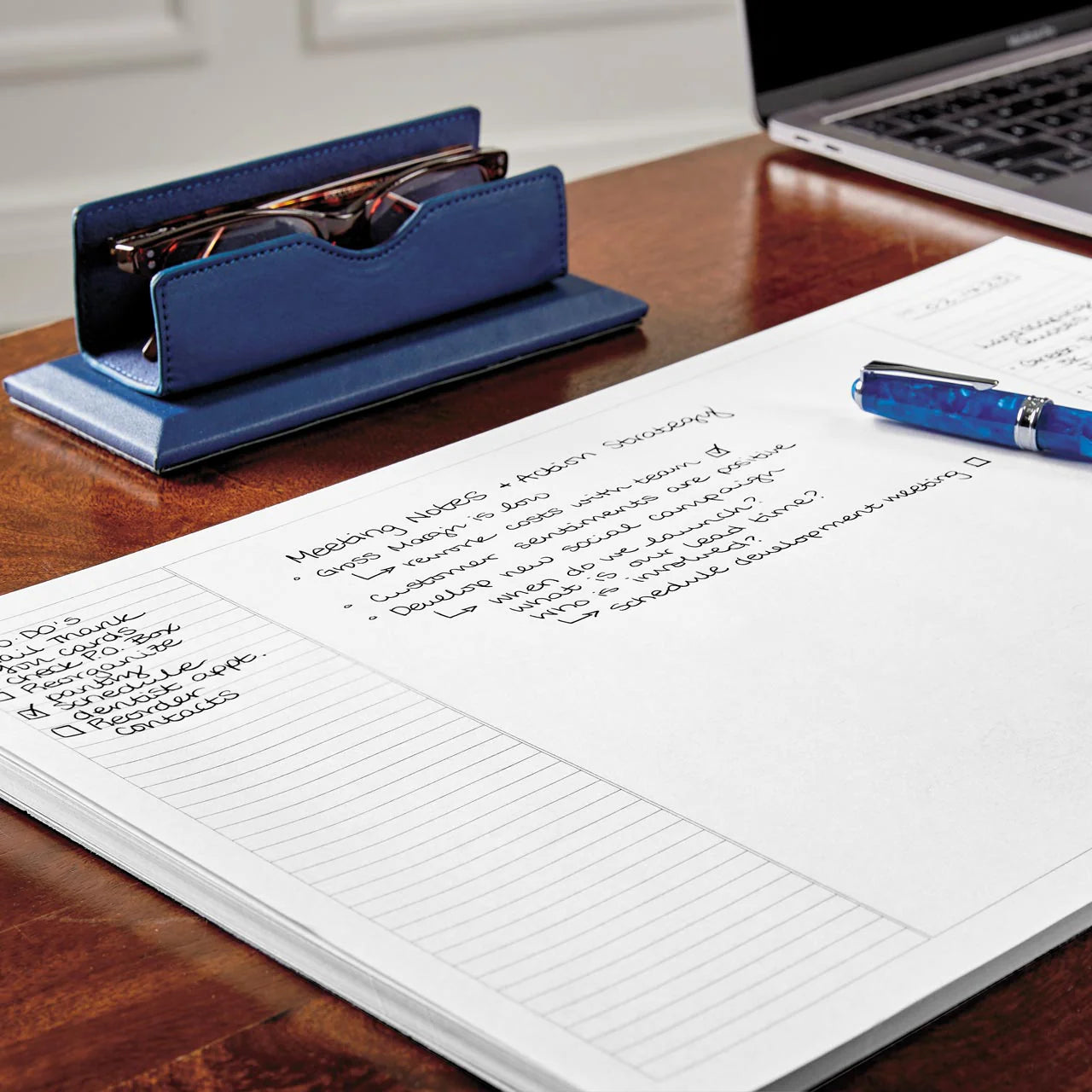
The best paper for a fountain pen is the one that does not bleed, feather, or ghost. Below you’ll find how Levenger’s current Circa and Freeleaf papers behave with fountain pens, what their gsm ratings mean in practice, and which options to choose for clean lines, controlled drying, and minimal show-through. Observations are based on our photographed nib-and-ink tests completed July 8, 2026 for United States readers.
How Paper Influences Fountain Pen Results
- Weight (gsm): Heavier sheets (around 120 gsm) give broader nibs and wetter inks more headroom before ghosting or bleedthrough. Mid-weight 100 gsm balances crispness with reasonable dry times. Lightweight 90 gsm keeps notebooks slim but can show on the reverse with wet combinations.
- Surface sizing & finish: Balanced sizing keeps ink at the surface long enough to form a sharp line. Paper that’s too open feathers; paper that’s very slick may extend dry time.
- Ruling & layout: Annotation/Cornell margins structure actions and summaries, while grid or dot layouts support diagrams and wireframes.
What Our Photographed Tests Showed (Quick Answer)
We tested extra-fine (EF), fine (F), medium (M), and broad (B) steel nibs with conservative blue‑black, saturated blue, and a sheening teal. Here’s the pattern we saw across Levenger families:
- 120 gsm Circa refills: Clean edges and the least ghosting with M–B nibs and wetter inks; drying is modestly longer, so blotting helps during page turns.
- 100 gsm Circa refills: The everyday sweet spot for F–M nibs. Most inks behaved without bleedthrough; very wet M/B combos may show a light shadow.
- 90 gsm Circa refills: Best with EF–F nibs and well‑behaved inks if you want to write both sides. We observed occasional feathering with very wet M/B pairs. Note that some 90 gsm refills are labeled on‑site as not fountain‑pen friendly; if you like wetter inks, step up in weight.
- Freeleaf pads (90 gsm classic; select formats 100 gsm): Smooth and forgiving desk pads. The 90 gsm Annotation styles performed well with F/M nibs; 100 gsm formats were notably tolerant of wetter inks.
- Circa 5-Year Journal Refill (185 sheets) — Heavier Circa refill with plenty of sheets for projects needing clean edges and minimal ghosting.
- Circa International Annotation 1/4 Ruled Discbound Refill (300 sheets) — Large-count Circa discbound refill useful for long notes or packets where ghosting must be minimal.
- 3-Ring Annotation Ruled Refill (100 sheets) — Standard 3‑ring Circa annotation refill for everyday use with medium–broad nibs that still resists show‑through.
- J Herbin Blotting Paper — Blotting paper to speed drying and prevent smudges when using wetter M–B nib and ink combos.
Decision Matrix: Match Your Setup to Levenger Paper
Compare your choices by nib size, ink behavior, and tolerance for ghosting. Use this as a practical map from our tests.
| Paper & Weight | Best Nib/Ink Fit | Strengths | Watch‑outs | Ideal Uses |
|---|---|---|---|---|
| Circa 120 gsm refills (e.g., planners, memo/steno, specialty refills) | Fine–Broad; moderate to wet inks, sheen/shimmer | High bleed/feather resistance; shows shading/sheen beautifully | Longer dry times; slightly heavier notebook | Signatures, client packets, archival notes |
| Circa 100 gsm (Luxe/Shaded/Midway Annotation, Landscape Annotation, Engineer Grid) | Fine–Medium; most daily inks | Smooth, substantial; balanced drying; versatile rulings | Light ghosting with very wet M/B nibs | Meeting and project notes; diagrams on grid |
| Circa 90 gsm (Full‑Page Ruled, Dot/Grid, Full‑Page Grid) | Extra‑fine–Fine; drier inks | Lightweight, economical; portable | More show‑through with wet inks and broad nibs | Lists, field notes, drafting ideas |
| Freeleaf Annotation Pads 90 gsm (white/yellow/multicolor) | Fine–Medium; moderate inks | Firm backer; smooth for desk work | Pad format; not discbound | Desk notes, phone logs, quick handoffs |
| Freeleaf Grid/Square and select 100 gsm pads | Fine–Broad; moderate to wet inks | Heavier pad stock; generous writing area | Fixed page sizes | Brainstorms, compact desk pads, sketching |
- Levenger Rollerball Ink Refill Sampler (set of 6) — A sampler of rollerball inks to evaluate ink behavior and compatibility across different Circa weights.
- True Writer Classic Royal Pen — A dependable everyday fountain pen to test nib size and paper pairing in your decision matrix.
Paper‑by‑Paper Notes From Our Tests
Circa 120 gsm: Confidence with Expressive Inks
What we saw: With a wet M nib and a teal ink prone to sheen, lines stayed crisp with minimal halo. Broad nibs showed rich shading. Dry times were 2–4 seconds longer than 100 gsm in similar conditions.
Use it if: You value clean backs of pages, sign often, or enjoy saturated or shimmering inks. Left‑handers can pair with faster‑drying inks or a blotter for smoother page turns. Practical strategies appear in Left‑Handed Writing Tips: Smudge Control and Line Choice.
Circa 100 gsm: The Daily Driver
What we saw: F and M nibs produced crisp strokes with conservative blue‑black and saturated blues. A wet B nib revealed faint ghosting but no bleedthrough on annotation formats and on Engineer Grid. Landscape Annotation made meeting minutes easy to scan.
Use it if: You want balance—smooth feedback, reasonable dry times, and notes that hold up to highlighting. To fine‑tune line feel by nib, see Nib Selector: Fine, Medium, Broad—Line, Feedback, and Paper Pairings.
Circa 90 gsm: Light and Portable
What we saw: EF and F nibs with well‑behaved inks kept the reverse usable. Very wet M/B combos showed ghosting and occasional feathering, so we reserved those pairs for 100–120 gsm. If you rely on wetter lines, avoid 90 gsm variants specifically noted as not fountain‑pen friendly.
Use it if: You favor slim notebooks or lighter carry and typically write with fine lines. If you upgrade later to broader nibs, step up in paper weight. For pen body and grip comfort, consult Ergonomics & Balance: Matching Pen Weight and Diameter to Your Grip.
Freeleaf Pads: Friendly, Desk‑Ready
What we saw: The 90 gsm Annotation pads were smooth with F/M nibs and standard office inks; our sheening teal showed mild ghosting but stayed neat. 100 gsm pad formats (e.g., square or full‑page grids) handled wetter lines with cleaner reverses.
Use it if: You prefer a firm writing surface and tear‑off pages. For structured notes, Annotation/Cornell layouts keep action items clear.
- Circa Soft Focus Annotation Ruled Refill (300 sheets) — High-count Circa soft‑focus annotation refill for crisp strokes and minimal show‑through with expressive inks.
- Circa Annotation Ruled Discbound Notebook — Classic Circa ruled discbound notebook that preserves line crispness for everyday fountain‑pen use.
- Circa Leather Discbound Notebook — Durable Circa leather discbound notebook for archival notes and expressive ink use with minimal ghosting.
Pairing Tips: Nib Size, Ink Flow, and Dry Time
- Fine nib + modestly wet ink: 100 gsm often feels just right—clean lines with reasonable drying. If you want pristine backs of pages, step up to 120 gsm. For line‑width expectations by nib, see Nib Selector: Fine, Medium, Broad—Line, Feedback, and Paper Pairings.
- Medium–Broad or expressive inks (sheen/shimmer): Start at 120 gsm for crisper edges and less ghosting.
- Left‑handed writers: Favor 100 gsm for faster perceived drying, or pair 120 gsm with a blotter and quick‑dry inks. Hands‑on tactics are in Left‑Handed Writing Tips: Smudge Control and Line Choice.
- Trying 90 gsm: If portability or cost is paramount, 90 gsm can work with EF/F nibs and well‑behaved inks—try a single sheet before a long session. To tune feel and feedback, visit True Writer Buyer’s Guide: Bodies, Nibs, Finishes, and Interchangeable Options.
Ink choice shapes outcomes as much as paper. For drying time, water resistance, and shading, explore Ink 101: Cartridges vs. Bottled, Drying Time, Sheen, and Water Resistance.
Real‑World Setups: What Works Where
- Client signatures or formal letters: 120 gsm minimizes show‑through and preserves crisp strokes. A steady, comfortable writer like the art‑deco styled Levenger Great Gatsby Fountain Pen pairs well for confident lines.
- Daily project notes at the office: 100 gsm Luxe or Shaded Annotation balances smoothness and practicality. A medium nib on the refined True Writer Two‑Tone Herringbone Anniversary Fountain Pen offers fluid writing without excessive wetness.
- Light, mobile carry: Choose 90 gsm refills to reduce bulk and stick to fine nibs with conservative inks. A fine nib on the sea‑hued True Writer Classic Sea Glass Fountain Pen is a pleasant travel companion.
- Reflective journaling: Many writers prefer 120 gsm for minimal bleedthrough; if you sketch diagrams, the 100 gsm Engineer Grid offers structure without visual clutter. For pen body fit and fatigue‑free sessions, see Ergonomics & Balance: Matching Pen Weight and Diameter to Your Grip.
- Levenger Great Gatsby Fountain Pen — Art‑deco styled Levenger fountain pen recommended for confident, steady signatures on heavier stock.
- True Writer Two-Tone Herringbone Anniversary Fountain Pen — A refined two‑tone True Writer that pairs well with medium nibs for flowing office writing.
- Circa Modern Sliver Discbound Notebook — A slim Circa discbound notebook for daily project notes that pairs with office pens and mid‑weight refills.
Why Levenger Paper Can Be a Smart Value
Levenger often specifies heavier, archive‑quality paper in work‑ready formats, so fountain‑pen enjoyment doesn’t require babying your notebook. In the U.S., you’ll frequently find seasonal promotions, a loyalty program, and bundle‑friendly formats that keep ongoing refills cost‑effective. While some premium items are an investment, many refills and pads are competitively priced—especially during periodic deals—so you can choose by use case rather than compromise on paper.
- Circa Luxe Annotation Ruled Discbound Refill (100 sheets) — Circa Luxe discbound refill in a compact 100‑sheet format for durable, fountain‑pen‑friendly pages.
- Notabilia Notebooks (set of 2) — A value set of Notabilia notebooks that provide affordable, work‑ready pages for regular fountain‑pen use.
Care & Upkeep: Keep Lines Clean
- Maintain healthy flow: A quick pen flush when changing inks prevents residue that can masquerade as paper feathering. See Maintenance Rituals: Cleaning, Flushing, and Safe Storage.
- Tune feedback, not pressure: If you’re chasing line character, try specialty nibs and practice on 120 gsm before moving to lighter stocks. Start with Calligraphy & Special Nibs: When to Experiment and How to Practice.
- Consumables fit: If you swap cartridges or bottled systems, see Refills & Converters: Getting the Most from Your Levenger and Partner Brands to prevent flow surprises that can look like paper issues.
- Everyday comfort: If your hand tires, adjust pen weight and balance before pressing harder. Guidance here: Ergonomics & Balance: Matching Pen Weight and Diameter to Your Grip.
Frequently Asked Questions
Is Levenger’s 90 gsm Circa paper fountain‑pen friendly?
Often, yes—with extra‑fine or fine nibs and moderate inks if you plan to use both sides. If you prefer wetter inks or broad nibs, start at 100–120 gsm for more margin, and avoid 90 gsm variants specifically noted as not fountain‑pen friendly.
Which Levenger paper weight most reliably minimizes ghosting and bleedthrough?
Levenger’s 120 gsm Circa options provide the most headroom for wetter inks and broader nibs. Many 100 gsm refills handle fine–medium nibs cleanly with balanced dry times.
What about dry time on heavier papers?
All else equal, 120 gsm typically dries a touch slower than 100 gsm because more ink sits at the surface. A gentle blot or quick‑dry ink restores page‑turn speed without sacrificing line quality.
I’m left‑handed—should I avoid heavier paper?
Not necessarily. Pair 120 gsm with quick‑dry inks or use 100 gsm for faster perceived drying. For more techniques, see Left‑Handed Writing Tips: Smudge Control and Line Choice.
Next Steps
If you’re deciding between nibs and paper, begin with 100 gsm for daily notes and keep a 120 gsm refill nearby for signatures, journaling, or expressive inks. When you’re ready to refine your setup, explore Pen & Ink Mastery: True Writer and Beyond and compare writing instruments in Choosing Your Everyday Writer: Ballpoint vs. Rollerball vs. Fountain. If you enjoy expressive nibs, visit Calligraphy & Special Nibs: When to Experiment and How to Practice to try italics and stubs on heavier stock.
- Circa Half-Sheet Ruled Discbound Refill (100 sheets) — A practical 100‑sheet Circa half‑sheet refill—ideal as your daily 100 gsm starter for notes and planning.


