
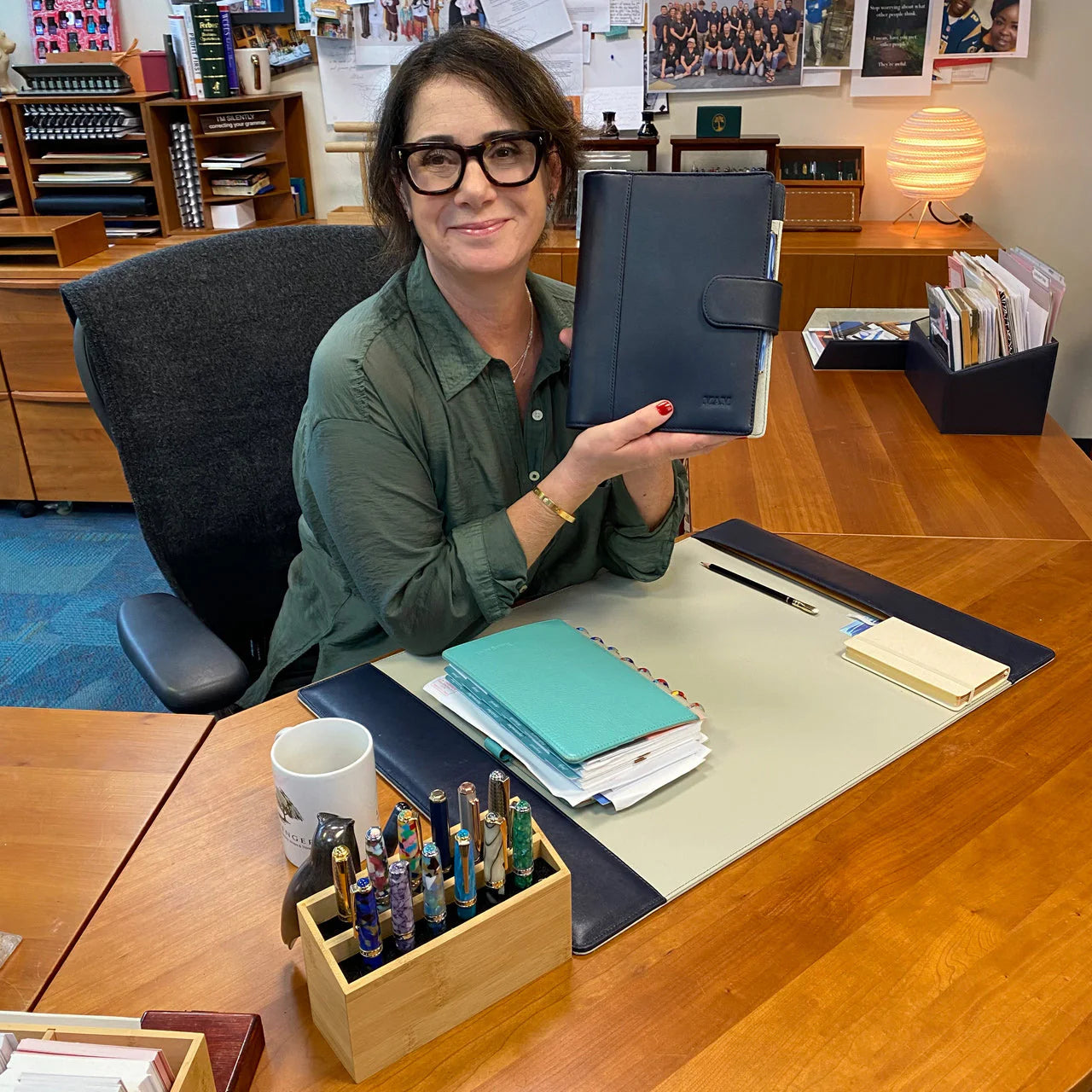
Your lunch break can be more than a refuel—it can be a reliable, 60‑minute window to write, think, and store ideas you’ll use later. This guide helps you assemble a portable kit that’s refined enough for the office and small enough for a park bench or café table. You’ll find practical configurations, a comparison of formats, and care tips so your tools age beautifully.
What to Pack: The Core Pieces
Keep the kit lean so it fits on a tray table or a narrow city bench. Four essentials cover most writing styles:
- A compact notebook for narrative journaling: A junior‑size discbound or a slim stitched notebook gives you uninterrupted pages for reflection and longer entries. If you want a ready‑to‑build disc system with paper and accessories, the Super Circa Bundle is a strong foundation for portable journaling.
- Fast‑capture cards for quick notes: 3x5s are nimble when you’re on the move, and they separate nicely by project or mood. A small desktop home like the Bamboo Note Card Nook makes it easy to stage fresh cards at work, then slip a day’s stack into your folio.
- A pen you enjoy using: Smooth, reliable, and comfortable for 1–3 pages at a time. A protective carry with an always‑ready writing surface—like the zip‑secure Leather Pen Folio—doubles as a 3x5 platform for jotting on small surfaces.
- A tidy way to carry: If you prefer a self‑contained writing station that sets up anywhere, the solid‑wood Writer’s Traveling Tool Box converts to a mini editor’s desk for stable handwriting during lunch.
Choose Your Capture Format
Different mid‑day moments call for different paper. Use this comparison to pick your primary format and a compact backup.
| Format | Portability | Speed of Capture | Organization | Best For |
|---|---|---|---|---|
| Junior discbound notebook | Slips into most briefcases and totes | Moderate (open, write, rearrange later) | High (rearrange pages, add sections) | Journaling, meeting reflections, light planning |
| Pocket notebooks (A6–Field Notes size) | Excellent; jacket or small bag | Fast (always open to a new page) | Moderate (one book per theme or month) | Daily log, micro‑journaling, quotes on the go |
| 3x5 index cards | Excellent; stack or card wallet | Fastest (one idea per card) | High (sort, tag, discard easily) | Idea capture, outlines, research snippets |
| Tri‑folio with pad + pockets | Good; slim but structured | Moderate (open flat, write, store) | High (sections, card slots, slips) | Working lunches, 1:1s, quick reviews |
If you enjoy engineering‑style layouts for sketching and structured notes, a ready‑to‑go kit like the Circa L‑Tech Engineer Notebook Bundle offers gridded pages and accessories that keep diagrams and lists crisp in a compact footprint.
Smart Lunch‑Hour Routines (10–60 Minutes)
- 10 minutes: One page of freewriting (date, mood, one question you’re exploring). Then one meaningful sentence to carry back to work.
- 25 minutes: A “sprint” of cards: write 8–10 single‑idea 3x5s. Title, one claim or observation, and a next action. For a deeper dive on this cadence, see Analog Sprinting: 25‑Minute Task Bursts Using To‑Do Pads and Pocket Briefcases.
- 45–60 minutes: Journal for 20–30 minutes; spend the remainder sorting cards and flagging two actions to schedule later.
If you like to anchor your midday writing with a morning setup, you might enjoy Analog Mornings: A 20‑Minute Paper‑First Routine to Set Your Day’s Focus. And to transform quick notes into steady progress, try weekly reviews from Analog Habit Tracking: Dot‑Grid, Index Cards, and Simple Weekly Reviews.
Carry Options That Work in the Real World
Lunch breaks rarely happen at spacious desks. Here are compact carries tailored to common U.S. scenarios—from commuter trains to café counters.
- Briefcase or tote, office café: A slim organizer like The Multitasker Tri‑Folio keeps a pad, cards, and essentials flat and ready. It opens neatly on narrow tables without sprawling.
- Walking meeting or park bench: The Leather Pen Folio provides a firm card platform when you don’t have a table—great for capturing quotes or follow‑ups on foot.
- Café counter or airplane tray: If you prefer a structured station, the Writer’s Traveling Tool Box elevates the writing surface for comfort and keeps pages and a phone from sliding.
For days when you want an all‑analog break kit—pens, cards, and a small notebook at the ready—see The Analog Break Pack: What to Carry for Screen‑Free Moments on the Go.
Paper Choices: Smoothness, Weight, and Ink Behavior
Look for paper that’s smooth enough for quick notes yet substantial enough to resist feathering and show‑through—especially if you prefer rollerball or fountain pens. Levenger’s writing papers are engineered to be fountain‑pen friendly, which helps lunch‑hour pages stay legible on both sides and makes smaller notebooks more economical over time.
If you want a colorful or themed journaling experience, consider a seasonal discbound set like the peony or floral ensembles; for a minimal, utilitarian feel, engineered grid formats make outlines and diagrams fast. For stitched portability without discs, the slim Companion Notebook Series (set of 4) or the Busy Notebook (set of 3) ride easily in small bags and separate projects cleanly.
- Freeleaf Annotation Ruled Pads (set of 5) — Annotation ruling leaves a margin for the second pass, which is what a short session is actually for.
- 100 Dot Grid 3 x 5 Cards — Cards for the ideas that do not belong in the notebook yet.
Setups by Writing Style
- Reflective journaling: A junior discbound from the Super Circa Bundle, one fine or medium rollerball, and two dividers: one for “entries,” one for “prompts.”
- Idea harvesting and research: A pocket notebook plus 3x5s. File keepers at your desk—such as the Bamboo Note Card Nook—let you sort cards into themes after lunch.
- Sketch‑heavy thinkers: The Circa L‑Tech Engineer Notebook Bundle offers grids for diagrams, with discs so you can move sketches next to related notes.
- Minimalist, all‑in‑one: A structured carrier such as The Multitasker Tri‑Folio with a pad, pen, and a slim stack of cards—set up in under a minute.
Rituals That Make the Hour Count
- Begin with a page title: Date, place, and a 3‑word theme (“hiring plan draft”). It accelerates recall later.
- Write first, sort later: Use your uninterrupted block for capturing, not formatting. Sort cards or move discbound pages after you eat.
- End with a tiny handoff: Circle two actions to schedule after 1 p.m. For a simple daily shutdown that keeps momentum, try End‑of‑Day Reset: A 10‑Minute Analog Shutdown Using 3x5 Cards and a Desk Tray.
One pen that always works
Chroma Facet Ballpoint Pen — a lunch hour is too short to coax a pen into starting — this is the argument for a ballpoint in the bag whatever else you carry.
Care, Longevity, and Value
Well‑made tools invite use. Full‑grain leather folios and durable woods develop character rather than wearing out, and refillable systems minimize waste over time. Levenger is known for elevated materials and thoughtful engineering; while some items are premium, they’re built to be refilled for years, which can be more cost‑effective than disposable notebooks. You’ll also find frequent promotions and loyalty benefits that make upgrading your kit more approachable over time.
If you like a curated, giftable assortment that’s priced sensibly for building an analog habit, explore thematic sets such as the Canvas Script and Scribble Analog Bundle—a straightforward way to start without over‑packing.
Frequently Asked Questions
How small should my lunch‑hour kit be?
As a rule, it should fit comfortably on a 24–26 inch café table or an airline tray. One compact notebook, a short stack of 3x5s, and a single pen cover most needs without crowding your meal.
What paper works best if I use fountain pens?
Choose smooth, heavier‑weight pages designed to reduce feathering and show‑through. Levenger’s refills are formulated for fountain‑pen friendliness so you can write on both sides and keep a smaller notebook lighter.
Should I pick a discbound notebook or pocket notebooks?
Pick discbound if you want to rearrange pages, insert checklists, and build sections. Choose slim stitched notebooks if you prefer separate books per project or month and want maximum portability. Many writers carry both: one primary journal plus a pocket notebook for overflow.
How do I keep lunch‑hour notes from getting lost in the afternoon rush?
End each session by tagging two actions (star or box) and dropping any 3x5s into the first pocket you’ll open after lunch. A structured carrier like The Multitasker Tri‑Folio or a pen case with card storage such as the Leather Pen Folio makes that handoff simple.
Next Steps
Start with one primary format and a simple carry, then let usage guide your upgrades. If you’re rebuilding attention spans and want more screen‑free depth, explore Deep Work Without Distractions: Building a Screen‑Free Block with Circa, Freeleaf, and a Timer. When you’re ready to expand, add a stitched set like the Companion Notebook Series (set of 4) for project‑based writing or a travel‑ready station like the Writer’s Traveling Tool Box for anywhere journaling.


