
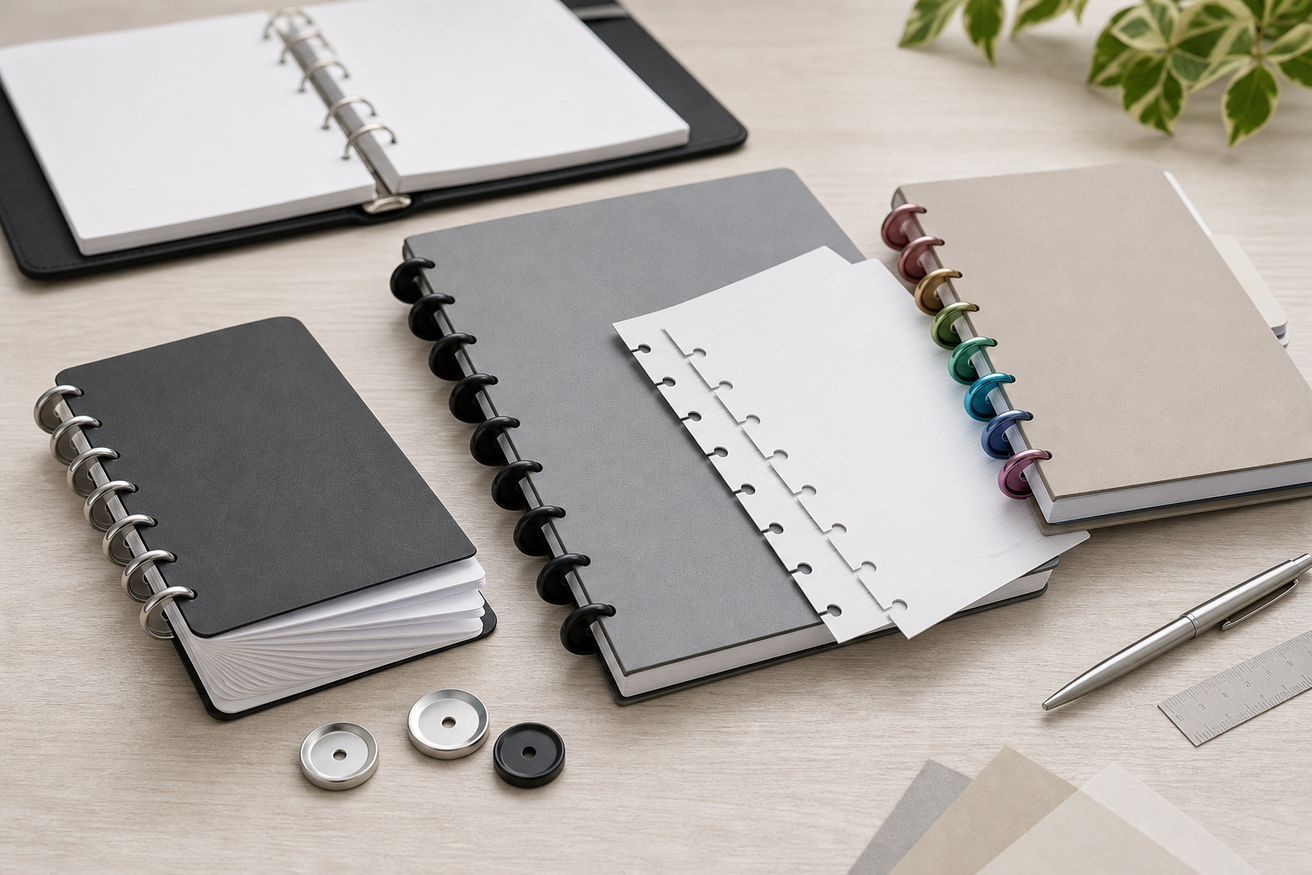
Great tools don’t just capture ideas; they help you move ideas forward. That’s why many professionals choose a disc‑bound notebook: you can add, reorder, or archive pages in seconds without the bulk of traditional rings. This guide explains how Levenger Circa compares with other disc‑bound options like Staples Arc and Office Depot TUL, what usually mixes well across brands, and when a classic ring‑binder planner from Filofax or Franklin Covey is still the right call. You’ll also find pragmatic advice on disc sizes, materials, paper fit, measured cross‑brand test results, and a thoughtful look at total cost over time—so your pages turn smoothly and your system keeps pace with real work.
How disc‑bound works—and why small tolerances matter
Modern disc‑bound systems rely on a row of mushroom‑shaped punches along the page edge. Those punches flex over the rim of a disc; the disc’s profile holds pages securely while still allowing you to remove and replace sheets as your projects evolve. Because the discs are separate components, you scale capacity by swapping disc diameters instead of replacing an entire notebook. The details you can’t see are just as important: the depth and polish of each punch, the smoothness of the disc rim, and how the paper stock and tabs interact with both. When tolerances align, pages glide; when they don’t, you feel hesitation or snagging.
Cross‑brand compatibility at a glance
Shoppers often ask if discs and paper from Arc or TUL will work with a Circa setup. In many everyday combinations, they do—because a shared mushroom‑punch concept and similar spacing have become the de facto standard across much of the U.S. disc‑bound market. Still, there are exceptions driven by punch depth, disc edge finish, and cover thickness. For a practical checklist of what typically fits, what to double‑check, and how to troubleshoot page snagging, see Disc compatibility: do Arc and TUL discs fit Circa?.
Disc‑bound and ring‑binder systems compared
If you’re choosing for daily work, you’re deciding between two binding philosophies. Circa, Arc, and TUL are all disc‑bound and feel quick to reorganize with a flatter writing surface. Filofax and Franklin Covey use ring mechanisms that offer a traditional binder spine and decades of insert formats. The right answer depends on how you write, carry, and archive. Use the comparison below to align each system to your priorities.
| System | Binding feel | Common U.S. sizes | Reorganization speed | Who it suits |
|---|---|---|---|---|
| Levenger Circa | Flat writing surface; smooth page turns with well‑finished discs | Junior (5.5×8.5 in), Letter (8.5×11 in) | Very fast—lift, move, and re‑index without metal rings | Professionals who reshuffle projects, capture printouts, and archive frequently |
| Staples Arc | Disc‑bound feel similar to Circa; varies by disc material | Junior/half‑letter, Letter | Fast—comparable to Circa in most mixes | Value‑oriented setups with broad store availability |
| Office Depot TUL | Disc‑bound; feel depends on discs and paper finish | Junior/half‑letter, Letter | Fast—generally on par with other disc systems | Users mixing accessories from big‑box sources |
| Filofax | Ring mechanism; structured tabbed sections | Personal, A5, others | Moderate—requires opening/closing rings | Planners who prefer a classic binder spine and fixed tab layout |
| Franklin Covey | Ring mechanism; long‑standing insert formats | Pocket, Compact, Classic, Monarch | Moderate—ring‑based insert changes | Users invested in legacy ring templates and reference sets |
For a concise, work‑centric head‑to‑head of disc‑bound options that maps priorities like writing feel, disc materials, and size availability, read Circa vs Staples Arc vs TUL: which disc‑bound system fits your work. If you’re also weighing rings and bound journals, you’ll appreciate the broader context in Disc‑bound vs ring binder vs bound notebook: choosing a system.
Our cross‑brand evaluation: what we tested and what we found
To answer the compatibility question with real‑world evidence, we ran a simple in‑house evaluation across common mixes that professionals actually use. The goal wasn’t to crown a winner; it was to help you predict fit and feel before you rebuild your notebook.
Method in brief
- Paper and tabs: standard letter‑weight writing paper, heavier project sheets, and laminated index tabs.
- Discs: resin/plastic discs and polished aluminum discs in modest and larger diameters.
- Punch sources: pre‑punched sheets from each brand plus a sample set punched on a Circa punch depth profile.
- Use cases: 1) daily‑carry notebook flips, 2) rapid re‑indexing of sections, 3) removing and reinserting printed packets.
Key findings you can use
- Most cross‑mixes between Circa notebooks and Arc or TUL paper/discs worked smoothly for everyday use. Occasional resistance typically traced back to shallow mushroom cuts or discs with prominent mold seams rather than fundamental spacing conflicts.
- Upgrading the disc surface finish often improved mixed‑brand builds more than changing paper. Metal discs with a polished rim reduced friction when flipping heavier project stock and laminated tabs.
- Heavier covers amplify edge stress at the top and bottom discs. If you use thick leather or composite covers, confirm those outermost mushrooms are crisply cut and leave a touch of clearance so covers don’t rub the page stack.
- For teams that pass documents between U.S. Letter and international A4, keeping separate notebooks for each format avoided odd overhangs and reduced wear on the outermost mushrooms.
Want a fast side‑by‑side of how the main disc‑bound systems feel day to day? You’ll find a pragmatic summary—and tips to match the system to your work—in Circa vs Staples Arc vs TUL: which disc‑bound system fits your work. For a closer look at disc materials and a short page‑turn demonstration, see the explainer Discs Demystified: Plastic vs. Aluminum vs. Specialty—Capacity, Feel, and Style.
Disc materials and diameters: comfort, capacity, and longevity
Disc diameter sets capacity; disc material sets the turning feel and long‑term durability. Resin or plastic discs keep weight and cost low, but a visible seam on some molded discs can add micro‑friction that shows up with stiffer papers or laminated tabs. Polished aluminum tends to present a consistent, smooth rim that feels almost like a bearing under the page stack—noticeable if you flip frequently or carry thicker sections.
- Daily flip frequency high? Consider a durable upgrade such as aluminum Circa discs to minimize edge drag over time.
- Prefer a subtle, non‑reflective aesthetic with the same smooth turn? matte aluminum discs deliver a restrained look without giving up feel.
- Color‑coding large project archives? A finish that stands out—like prismatic aluminum discs—helps you spot the right notebook at a glance. If you favor a classic palette for client‑facing work, consider Precious Metals aluminum discs for a refined tone.
As you size up discs, remember the tradeoff: larger diameters carry more but lift the writing surface higher off the desk. Many professionals keep a daily‑carry notebook on modest discs for comfort, then archive finished pages to a larger‑disc set back at the desk. For a visual primer on how capacities map to sizes and working styles, see Circa Sizes Explained: Jotlet, Compact, Junior, Midway, Letter—Which Fits Your Day?.
- Circa Clincher Discs (set of 11) — Clincher discs grip the punch more firmly than standard rims — the fix when pages work loose in a heavy build.
- Matte Aluminum Circa 1" Notebook Discs (set of 11) — One-inch aluminium for the archive set, once the working notebook outgrows its discs.
Choosing your notebook size for U.S. work—and collaborating globally
Most American offices default to Letter (8.5×11 in) for printed materials and Junior (5.5×8.5 in) for a more portable daily notebook. If you collaborate with partners outside the U.S., you may encounter A‑series paper (especially A4). Because hole geometry and page dimensions differ, mixing formats in a single notebook can feel untidy and may stress outer mushrooms over time. If you regularly print and punch documents, it’s simpler to build separate notebooks—one dedicated to Letter or Junior, another to A4—or use a digital bridge for the other format. For a quick orientation to how each Circa size supports different ways of working, read Circa Sizes Explained: Jotlet, Compact, Junior, Midway, Letter—Which Fits Your Day?.
Paper, tabs, covers, and punches: get a smooth cross‑brand setup
Mixing components across disc systems works best when you match three things: punch depth, paper stiffness, and disc finish. Before you commit a whole notebook to a new combination, try a short pilot section.
- Start with the paper you use most. Smoother, heavier stocks handle a wider range of pens and reveal disc edge quality more clearly. If you use laminated tabs or plastic pockets, include them in your test section.
- Check the punch depth and shape. A shallow cut fights the disc and can pop under lateral torque; an overly generous cut can wobble and snag during fast flips. If you’re evaluating Arc or TUL accessories with a Circa build (or vice versa), a quick read of Disc compatibility: do Arc and TUL discs fit Circa? will help you pinpoint the variable.
- Evaluate disc edge smoothness. Run a fingertip around the rim—burrs catch paper. If a mixed‑brand build feels hesitant, try smoother discs before changing paper you already love.
- Mind cover thickness. Thick composite or leather covers place extra stress on the top and bottom discs. Ensure those outer mushrooms are cleanly punched and leave a touch of clearance so covers don’t rub the stack.
Need a straightforward, no‑overwhelm path from empty desk to a working build (size, discs, cover, and paper) in one sitting? See Start Here: Build Your First Circa in 10 Minutes (Size, Discs, Cover, Paper).
Punching cross-brand paper
Circa Leverage Discbound Notebook Punch — a leverage punch cuts the Circa profile into stock from any system, which is what makes mixed paper a choice rather than a compromise.
Total ownership cost: how the numbers usually work out
Disc‑bound shines over time because you scale capacity by changing discs and moving pages—not by buying a new notebook for each project. Rings can be economical if you rarely reorganize and stick to fixed tab sets. Use this model to think about cost rather than chasing the lowest single price:
- Upfront build: cover + discs + starter paper. Rings add a mechanism; discs add a set of spines.
- Expansion: additional discs, refills, and tabs; rings expand by ring size and insert packs.
- Archiving: disc‑bound archives grow by adding discs and a simple cover or slip; ring archives grow by additional binders.
- Friction costs: time lost to slow page moves or snagging, wear from mismatched punches, or carrying bulk you don’t need.
To zoom in on value by tier—and where upgrades like aluminum discs pay back in daily use—read Is Circa worth it? What you get at each price tier. If you prefer to assemble a focused kit and keep spend efficient, this step‑by‑step is helpful: Build Your Own Bundle: How to Maximize Savings Without Sacrificing Fit.
A quick decision matrix for cost‑savvy builds
Use the table below to select a starting approach based on how you work rather than chasing the cheapest component.
| Build approach | Upfront spend | Expandability | Daily flip feel | Who it fits |
|---|---|---|---|---|
| Resin discs + simple cover + core refills | Lower | High (swap disc sizes; add refills) | Good; depends on disc finish and punch depth | New disc‑bound users validating workflow |
| Aluminum discs + durable cover + mixed refills | Moderate | Very high (robust for heavy use) | Very smooth, especially with tabs and thicker stock | Daily power users who reorganize often |
| Ring binder (Filofax/Franklin) with tab set | Moderate | Moderate (by ring size and insert packs) | Structured; slower to reshuffle | Users who value fixed tab layouts and a traditional binder spine |
When a ring‑binder planner is still right
Disc‑bound shines for active projects and fluid reorganization. But ring binders remain compelling if you’re invested in a specific ring format, need a traditional planner aesthetic, or maintain permanent reference sections that rarely change order. You give up the ultra‑flat writing surface and the quiet, quick reshuffling that discs offer; you gain the reassuring feel of a fixed spine with metal rings. For a focused, work‑planning perspective on how Circa compares with Filofax and Franklin Covey—what each system binds, how it carries, and who it suits day to day—see Circa vs Filofax and Franklin Covey for work planning. For higher‑level decision‑making across binding styles, revisit Disc‑bound vs ring binder vs bound notebook: choosing a system.
Putting it together: a practical build that grows with you
The most satisfying setups start with a simple kit you can evolve: choose the size that matches your carry, discs that meet today’s capacity with a touch of headroom, and a small palette of paper formats that mirror how you think (annotation‑ruled for meetings, dot or grid for planning, blank for sketching). As projects grow, split sections into a second notebook or move completed work to an archive set on larger discs. For a concise, confidence‑building walkthrough, see Start Here: Build Your First Circa in 10 Minutes (Size, Discs, Cover, Paper).
Starting from a complete build
Super Circa Bundle — covers, discs, refills and dividers sized to work together, so the first build is not an experiment in tolerances.
Key takeaways
- Circa, Arc, and TUL share a common disc logic; most mixes work well when punch depth and disc finish are in harmony.
- Disc material changes feel: aluminum’s polished rim noticeably improves page turns in high‑use notebooks.
- Choose size by the paper you actually carry (Letter or Junior in the U.S.; dedicate a separate build for A4 workstreams).
- Think in systems, not standalone notebooks: expand by disc size, not by starting over.
- Rings still make sense for structured, seldom‑changed planners—and for those who prefer a traditional binder spine.
Frequently Asked Questions
Do Arc and TUL discs fit Circa?
Often, yes. Many users mix these systems successfully because the spacing and mushroom‑punch concept are similar. Differences in punch depth, tab thickness, and disc edge finish can affect turning smoothness. For a practical checklist and quick troubleshooting, read Disc compatibility: do Arc and TUL discs fit Circa?.
How do I choose disc size?
Pick the smallest disc that comfortably holds your active pages plus a little headroom. Larger discs add capacity but raise the stack off the desk. If you flip often or use laminated tabs, smoother discs—like aluminum Circa discs—help pages glide even as you scale up.
Which size should I carry—Junior, Letter, or A4?
Match your primary printout size. U.S. teams typically favor Letter for desk work and Junior for portability. If you collaborate with A4 documents, keep a dedicated A4 notebook rather than mixing formats in a single build. For a quick orientation to how sizes map to work styles, see Circa Sizes Explained: Jotlet, Compact, Junior, Midway, Letter—Which Fits Your Day?.
When is a ring‑binder planner (Filofax or Franklin Covey) better than disc‑bound?
If you rarely reorganize, rely on fixed tab structures, or simply prefer the look and handling of a classic binder, a ring system can be the right choice. You give up the quick, silent reshuffling of discs, but you gain a traditional spine and long‑established insert ecosystems. For a work‑focused comparison, see Circa vs Filofax and Franklin Covey for work planning.


