
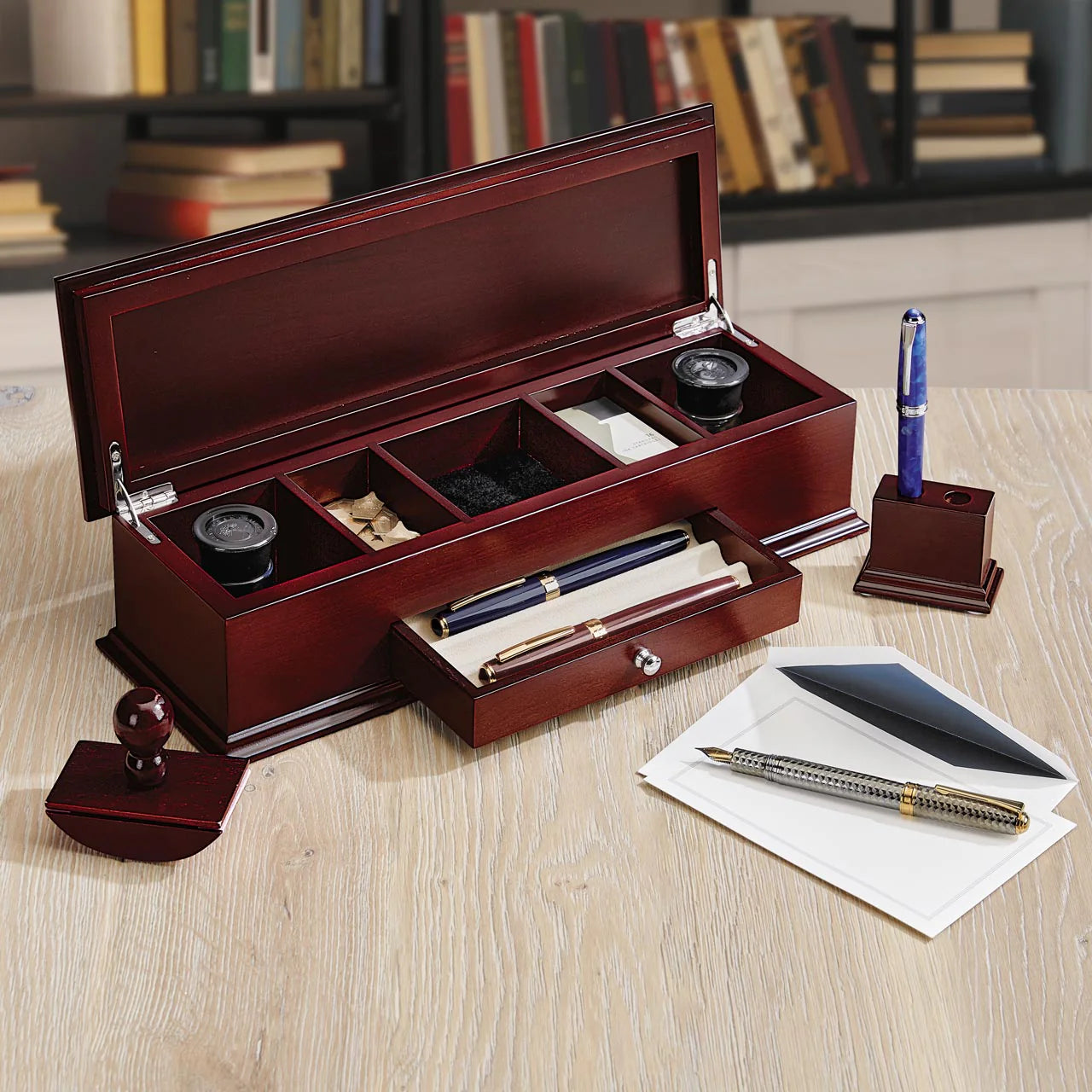
Your daily pen should match how, where, and on what you write. This guide compares ballpoint, rollerball, and fountain pens across feel, drying time, maintenance, and refills—then helps you choose a confident companion for meetings, margin notes, and personal correspondence. Levenger’s assortment spans all three, from pragmatic office workhorses to expressive instruments designed for decades of use.
The quick answer
- Choose a ballpoint if you want a reliable, low‑maintenance writer with fast drying and minimal smudge—ideal for forms, envelopes, and shared office paper.
- Choose a rollerball if you prefer a smoother, darker line than a ballpoint but still want simple cartridge swaps.
- Choose a fountain pen if you value expressive handwriting, low‑pressure comfort, and the ability to tune line width via nibs and inks.
Decision matrix: the three everyday options, side by side
Use this compact table to weigh what matters most for your routine in the U.S.—from quick notes on standard copy paper to longer letters on stationery.
| Pen type | Writing feel | Dry time & smudge | Upkeep | Refill path |
|---|---|---|---|---|
| Ballpoint | Controlled, firm; works on a wide range of office papers and multi‑part forms | Very fast on typical U.S. copy paper; highly smudge‑resistant | Minimal—swap refills | Stick refills; long write‑outs and multiple tip sizes available |
| Rollerball | Very smooth, fluid; saturated strokes with light pressure | Moderate; can smudge on coated stock until set | Low—rollerball refills | Water‑based ceramic or fiber‑tip refills; quick, tidy replacements |
| Fountain | Expressive, low‑pressure writing; nib choice alters line and feedback | Variable; depends on ink/paper pairing | Moderate—occasional cleaning | Cartridges or bottled ink via converter; many models offer interchangeable nibs |
How they write—and why it feels different
Ballpoint ink is oil‑based and viscous, which yields a controlled line that dries quickly and resists smearing. It excels on everyday paper, pocket notebooks, and forms—places where reliability matters more than ink shading. If you prefer a darker, smoother line without giving up ballpoint convenience, Levenger’s Easy Flow refills provide a gel‑like writing feel in a ballpoint format; see the handy two‑pack Levenger Easy Flow Ballpoint Refills (set of 2).
Rollerball ink is water‑based and lower viscosity. Flow through a ceramic or fiber tip produces a darker, smoother line with less hand pressure. Many Levenger rollerball models accept ceramic refills, and if you like a felt‑pen look that dries quickly, you can also use Levenger Fiber Tip Refills in compatible rollerballs.
Fountain pens channel liquid ink through a feed to a metal nib. Because they write with minimal pressure, they’re comfortable for long sessions. Your nib width (fine, medium, broad) and ink choice add character and control. For help dialing in line width and feedback, see Nib Selector: Fine, Medium, Broad—Line, Feedback, and Paper Pairings, and for creative scripts visit Calligraphy & Special Nibs: When to Experiment and How to Practice.
Recommended everyday scenarios
Fast notes, forms, and on‑the‑go writing
- Best fit: Ballpoint. Quick drying on office paper and receipts; great for signatures and addressing envelopes.
- Levenger pick: The compact, steady feel and classic resin of the True Writer Classic Titania Pen make it a polished daily ballpoint you can keep clipped to a padfolio.
Meeting notes and pages you’ll revisit
- Best fit: Rollerball for saturated, legible strokes that pop during review.
- Levenger pick: The weighty brass body and secure cap of the Engineer Rollerball Pen pair smooth writing with desk‑to‑conference‑room versatility.
- Prefer a gold‑accented silhouette at a wallet‑friendly price? The Vanguard Pen is a solid brass rollerball that feels substantial without being fussy.
Long writing sessions and personal correspondence
- Best fit: Fountain. Low hand pressure reduces fatigue; nibs and inks let you tailor line width and feel.
- Levenger picks: If you enjoy collectible resins, the True Writer Classic Flora Pen balances warmth in hand with visual character. For a shimmering, celebratory finish, consider the True Writer Classic Sunset Serenade Pen.
- True Writer Classic Titania Pen — A compact, reliable ballpoint with a steady resin body that’s ideal for quick notes and clipped carry.
- Engineer Pen — A weighty, brass rollerball that lays down smooth, legible lines for meeting notes and reviewable pages.
- Vanguard Pen — A versatile everyday pen with a balanced feel suitable for routine writing and on‑the‑go use.
- True Writer Classic Flora Pen — A comfortable, well-balanced resin pen that’s good for longer writing sessions and clear everyday strokes.
- True Writer Classic Sunset Serenade Pen — A polished resin option that combines a classic look with dependable everyday performance.
- Walletini Pen — A very compact, pocketable pen designed for quick access and fast on‑the‑go notes.
Ink, paper, and smudge control
Paper matters. Coated planners and glossy printouts slow dry times for rollerball and fountain inks; fibrous copy paper speeds drying but can feather with very wet inks. Left‑handed writers who brush across fresh lines often prefer fast‑setting ballpoint or a finer fountain nib with drier ink. See Left‑Handed Writing Tips: Smudge Control and Line Choice, match paper thoughtfully using Paper Compatibility: Which Levenger Papers Love Fountain Pens, and explore ink behavior in Ink 101: Cartridges vs. Bottled, Drying Time, Sheen, and Water Resistance.
Changing the line without changing the pen
Levenger Bottled Ink — ink is the cheapest variable in the system — a different bottle changes wetness, drying time and colour on the paper you already own.
Ergonomics: weight, diameter, and balance
The right diameter relaxes your grip, and the right weight prevents over‑pressing. Brass‑bodied pens feel reassuring and planted; resin‑bodied models feel nimble and warm to the touch. For simple at‑home tests, see Ergonomics & Balance: Matching Pen Weight and Diameter to Your Grip. If you appreciate organic materials, the hand‑turned profile of the True Writer Classic Wood Sprite Pen blends comfort with distinctive grain.
Refills, converters, and sustainability
Plan your refill path before you buy. Ballpoints use long‑lasting stick refills; Levenger offers classic formats plus Easy Flow for a gel‑smooth feel in ballpoint convenience—available in value‑minded multipacks like Levenger Easy Flow Ballpoint Refills (set of 6). Rollerballs use ceramic or fiber‑tip refills; if you prefer a felt‑like line that sets quickly, try Fiber Tip Refills. Fountain pens accept quick cartridges or a converter for bottled ink—often the most cost‑effective, low‑waste route over time. For deeper help, bookmark Refills & Converters: Getting the Most from Your Levenger and Partner Brands and the stewardship‑focused Sustainable Writing: Refill Strategies and Care for Decades of Use.
- Cuppa Pens Converter — Turns a cartridge pen into a bottle pen, which is where the cost per page drops.
- Levenger Easy Flow Ballpoint Refills (set of 2) — The low-effort end of the same argument: a ballpoint you refill instead of replace.
Care and travel
Ballpoint and rollerball pens are virtually grab‑and‑go. Fountain pens benefit from a light ritual: occasional flushing, capping between notes, and mindful ink choice for the paper at hand. See Maintenance Rituals: Cleaning, Flushing, and Safe Storage. For commutes and flights, practical packing tips live in Traveling with Pens: Flying, Leaks, and Everyday Carry. If you encounter skips or hard starts, visit Troubleshooting Flow: Skips, Hard Starts, and Scratchiness.
Good, better, best—by budget and temperament
- Practical and cost‑effective: Want Levenger quality at an accessible price? A straightforward rollerball or ballpoint is a smart start. The durable, brass‑bodied Engineer Rollerball Pen is a dependable office companion, while the giftable resin of the True Writer Classic Titania Pen offers understated sophistication.
- Expressive and collectible: If you relish tactile feedback and ink choice, a fountain‑friendly path invites experimentation. A nicely balanced resin such as the True Writer Classic Flora Pen is comfortable for long letters and journaling.
- Undecided or gifting: A two‑mode set lets recipients discover their preference. The Faber‑Castell Poly Fountain Pen and Ballpoint Gift Set bundles everyday practicality with room to grow.
Planning a small, meaningful assortment? Explore ideas in Starter to Collector: Building a Capsule Pen Collection. Displaying your favorites at home or in the office? See Presentation Matters: Cases, Stands, and Desk Display Ideas. If you’re weighing bodies, nibs, and finishes in our signature line, consult True Writer Buyer’s Guide: Bodies, Nibs, Finishes, and Interchangeable Options.
- Faber-Castell Poly Fountain Pen and Ballpoint Gift Set — A two‑mode gift set offering both a dependable ballpoint and an expressive fountain option for varied tastes.
- True Writer Classic Cafe Mocha Pen — A classic resin True Writer that offers accessible Levenger quality and comfortable daily use.
- True Writer Classic Killarney Pen — A nicely balanced True Writer that suits those who favor a tactile, expressive writing experience.
- True Writer Classic Elements Water Pen — A fountain‑friendly model for collectors and expressive writers who want ink variety and long‑form comfort.
- Levenger Classic Ballpoint Pen Refills (set of 6) — A practical pack of ballpoint refills to keep a budget‑minded everyday pen performing reliably.
Editorial note: how we choose recommendations
Every product mention here is an editorial pick. Our team prioritizes long‑term reliability, refill ecosystem support (including ceramic and fiber‑tip rollerball refills and widely available fountain pen cartridges/converters), comfort in hand, and design that holds up to daily use. We also consider total cost of ownership—Levenger often delivers high‑quality instruments that are more cost‑effective than expected, and seasonal promotions plus our loyalty program can make thoughtful upgrades even easier.
Levenger value: quality that earns its keep
Levenger instruments are built for everyday dependability—often with widely supported refills and, for many fountain pens, precise nib options—so ownership stays sensible year after year. Many customers find our pens are high quality and worth it, and that we regularly offer great values across the assortment. Keep an eye on limited‑time offers, and if you write often, our loyalty program can make refilling and occasional upgrades especially cost‑effective.
Frequently Asked Questions
Which pen type is least likely to smudge on standard office paper?
Ballpoint ink sets fastest and is the safest pick for signatures, forms, and quick notes. Rollerball ink looks darker but needs a moment to dry on slick or coated paper. Fountain ink depends on the specific ink and paper pairing.
I’m left‑handed—what should I choose?
Many left‑handed writers prefer ballpoints for the fastest dry times. If you like a darker line, try a finer rollerball or a fountain pen with a fine nib and a quicker‑setting ink, plus paper that resists smearing. For more strategies, see Left‑Handed Writing Tips: Smudge Control and Line Choice.
Do rollerball and fountain pens need special paper?
Not necessarily, but paper texture and coating affect dry time and feathering. Uncoated, fountain‑friendly sheets enhance shading and control; very glossy stock slows drying. For pairing advice, visit Paper Compatibility: Which Levenger Papers Love Fountain Pens.
How often should I maintain a fountain pen?
Light, regular care goes a long way. Flush the pen when changing inks or every few weeks if you write daily, and store it capped. See Maintenance Rituals: Cleaning, Flushing, and Safe Storage for an easy routine.


