
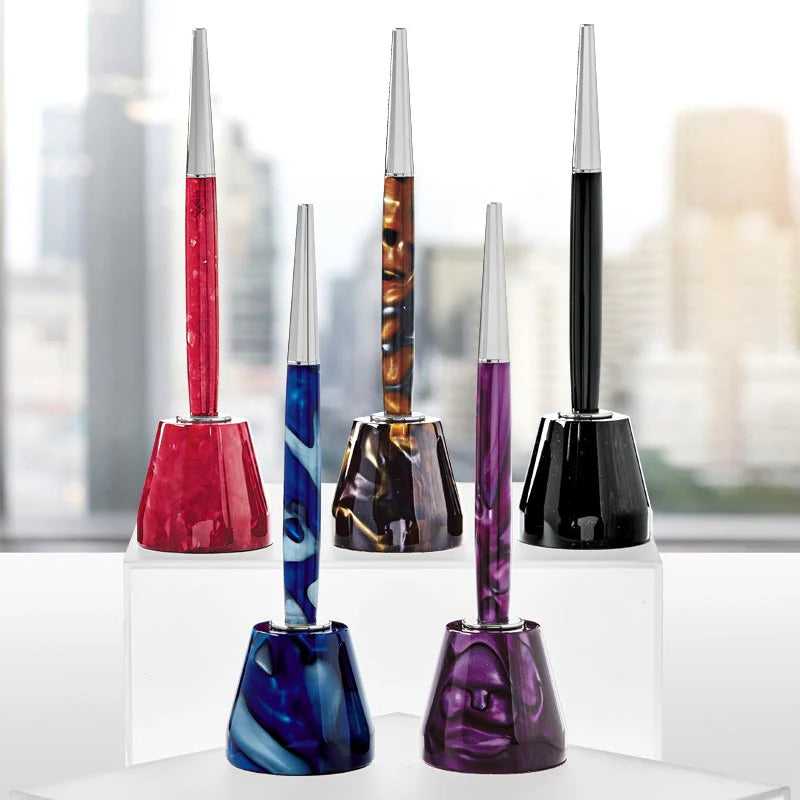
Pen & Ink Mastery: True Writer and Beyond
Great writing tools don’t just record ideas; they shape them. The balance of a well-made pen changes your posture. A tuned nib encourages a calmer rhythm. Paper that respects liquid ink helps your thoughts arrive as clean lines rather than scattered blots. When these choices work together—pen, nib, ink, paper, and thoughtful storage—you build a writing practice that’s both productive and deeply personal.
This Core Guide is your academy in one place: a practical, elegant path to choosing your everyday writer, fitting a fountain pen to your handwriting, selecting inks and papers that cooperate, caring for instruments so they last for decades, and organizing a collection that invites daily use. At key decision points, you’ll find focused guides that go deeper on specific topics. They’re written to be used—skim a section, try a recommendation that fits your context, return as your needs evolve.
The Levenger Approach: Tools That Reward Daily Use
Levenger’s design point of view is simple: a writing instrument should be comfortable for long sessions, dependable in professional settings, and worthy of care. Materials and finishes matter, but so do the quiet details you notice in the tenth meeting of the week—the feel of a section diameter that doesn’t ask you to over-grip, the way a converter refills cleanly, the balance of a posted cap that doesn’t tug on your hand. If you’re curious about how Levenger’s signature system comes together across bodies, nibs, and finishes, start with a focused overview in True Writer Buyer’s Guide: Bodies, Nibs, Finishes, and Interchangeable Options. That guide explains how the family feels in hand, how sizes map to real handwriting, and how interchangeable components keep a single pen adaptable as your preferences and paper change.
Everything that follows builds on the same idea: match the tool to the task, then refine. A single dependable everyday writer is more valuable than a tray of instruments you never reach for. Over time, a small capsule of complementary pens can cover your workday, travel, and longer thinking sessions without clutter or duplication. If you want a clear, pragmatic path from first choices to a focused 5–10 piece set, you’ll appreciate the approach in Starter to Collector: Building a Capsule Pen Collection.
Choosing Your Everyday Writer: Ballpoint, Rollerball, or Fountain?
Most writers do the bulk of their daily notes with one mechanism. Your choice should follow how you write, where you write, and on what paper. For a concise walkthrough—with matrix, scenarios, and Levenger-ready options—see Choosing Your Everyday Writer: Ballpoint vs. Rollerball vs. Fountain. Below is a decision matrix you can scan in under a minute. It’s not about declaring a winner; it’s about aligning strengths to your actual day.
Quick comparison: which mechanism fits your routine?
| Pen type | Writing feel | Dry time & smudge on typical U.S. office paper | Upkeep | Best for | Tradeoffs |
|---|---|---|---|---|---|
| Ballpoint | Controlled, tidy line; firm feedback | Very fast; highly smudge-resistant | Minimal—swap refills | Forms, quick notes, travel, mixed papers | Requires a touch more pressure; limited shading |
| Rollerball | Very smooth; saturated lines with light pressure | Generally quick; can look darker on thin stock | Low—cartridge changes | Meeting notes, signatures, journaling | Cap when not in use; some papers may show-through |
| Fountain | Effortless glide; tune line with nib/ink | Varies by nib/ink/paper; slower on coated sheets | Moderate—cartridges or bottled ink; periodic cleaning | Long sessions, expressive notes, letters | Prefers quality paper; modest learning curve |
Two practical notes. First, if you work on unpredictable office stock, a ballpoint or rollerball is a low-friction baseline; you can keep a fountain pen at your desk for longer writing. Second, many professionals carry two formats: a ballpoint for forms and envelopes and a fountain or rollerball for meetings and personal correspondence. The goal is intentional redundancy, not duplication.
- True Writer Classic Flora Pen — A Levenger-designed body that takes ballpoint, rollerball or fountain nibs, so you can change mechanism later without changing pens.
- Faber-Castell Poly Fountain Pen and Ballpoint Gift Set — Two mechanisms in one box if you would rather try both before committing to one.
Fountain Pen Fit: Nib Sizes, Line Character, and Paper Pairings
Nib size is where a fountain pen becomes your fountain pen. The choice isn’t abstract; it’s the width your letters occupy on the page, the margin space you keep for edits, and how quickly lines dry in a conference-room notebook. If you want a compact, scenario-based breakdown—line width, tactile feedback, speed, and paper matching—use Nib Selector: Fine, Medium, Broad—Line, Feedback, and Paper Pairings. It also explains how Levenger’s interchangeable nib units make experimentation easy without buying a new body.
How the main sizes behave in real work
| Nib size | Approx. line width | Where it shines | Tradeoffs | Paper pairing |
|---|---|---|---|---|
| Fine | ~0.6 mm | Compact handwriting, margin notes, narrow ruling | Less shading; can feel drier on plain copier paper | Handles lighter stock with less show-through |
| Medium | ~0.8 mm | General longhand, meeting notes, journaling | Slightly slower on very smooth, coated sheets | Balanced on quality note pads and most planners |
| Broad | ~1.0 mm | Signatures, headers, ink shading and character | Requires better paper; higher ink use | Prefers heavier papers with good sizing |
Because handwriting styles vary, you may land between sizes or prefer one nib at the office and another for weekend letters. If you’re exploring Levenger’s ecosystem, the True Writer family supports quick nib swaps—helpful when you want fine for annotation today and medium for reflective notes tomorrow. For body feel and compatibility specifics, see True Writer Buyer’s Guide: Bodies, Nibs, Finishes, and Interchangeable Options.
When you want the nib to do the talking
Levenger Great Gatsby Fountain Pen — an expressive writer for letters and signatures, where line character is the point rather than a side effect.
Ink 101: Cartridges, Bottled Rituals, Drying Time, and Permanence
Ink is the most frequent choice you’ll make. Cartridges keep your desk clean and your bag light. Bottled ink broadens color options and lowers cost per fill if you write often. Drying time and water resistance aren’t afterthoughts—they’re the difference between crisp pages in a fast meeting and a smeared signature on a glossy handout. For a clear side-by-side on formats, drying expectations, sheen versus shading, and when to choose document-friendly formulas, dive into Ink 101: Cartridges vs. Bottled, Drying Time, Sheen, and Water Resistance.
Working guidelines
- Cartridges suit travel, busy days, and shared workspaces. Keep a sleeve of your go-to color; swapping takes seconds and keeps hands clean.
- Bottled ink rewards a steady desk routine, color exploration, and cost-conscious writers who refill weekly. A converter bridges the two worlds.
- Drying time moves with nib size, ink flow, and paper. Fine nib + moderate-flow ink + quality paper is a pragmatic office trio.
- Permanence matters for official records and long-term notes. If your role includes signatures or archival correspondence, keep a water-resistant blue or black on hand for those tasks.
If you’re building a practical fountain pen setup from scratch, a capable converter is the quiet hero of reliability. A simple, tidy option for moving between cartridges and bottles is the converter for everyday desk refilling, which pairs particularly well with writers who split time between meetings and longer sessions at home. Use converters with a modest cadence of cleaning—more on that in the care section below.
Moving from cartridges to bottled ink
Cuppa Pens Converter — a converter lets you fill from any bottle, which is where the widest colour range and the lowest cost per fill live.
Paper That Loves Ink: Weight, Surface, and Layout
Paper transforms the same nib and ink into very different outcomes. Weight (gsm) and surface sizing influence line crispness, feathering, and dry time; ruling and layout shape how your notes flow. If you prefer a practical, Levenger-specific readout of which current refill papers handle fountain ink gracefully—and how to match gsm to nibs—open Paper Compatibility: Which Levenger Papers Love Fountain Pens. That guide summarizes how popular formats behave and suggests pairings for crisp lines with minimal ghosting.
Rules of thumb
- Heavier papers (100–120 gsm) usually reduce bleedthrough and preserve edge crispness, particularly with medium and broad nibs. Expect slightly longer dry times.
- Moderate weights (~90 gsm) keep notebooks slim and travel-friendly; fine nibs and moderate-flow inks help control show-through.
- Surface sizing that’s balanced allows ink to sit near the top long enough to dry into a defined line; overly absorbent sheets can feather, while overly slick surfaces extend dry time.
- Layouts matter. Annotation/Cornell-style pages encourage structured thinking; grids and dots support diagrams, wireframes, and margin checklists.
One practical test before a big project: write a short paragraph with your typical nib and ink across the bottom third of the page, then flip it and write at the top on the reverse. You’ll immediately see show-through and feel whether the surface slows or speeds your hand.
Ergonomics & Balance: Fit the Pen to Your Grip
Comfort is the foundation of legible, repeatable handwriting. It is shaped by three variables: weight, balance (especially whether you post the cap), and barrel diameter where your fingers actually rest. Most writers use a variant of the tripod grip, but even small differences—higher choke, a flatter angle, or a firmer squeeze—change what feels “natural” over an hour of notes. For structured tests, hand-size ranges, and practical picks, work through Ergonomics & Balance: Matching Pen Weight and Diameter to Your Grip. It offers quick home trials (without tools) to identify your weight and diameter window before you buy.
Field-tested pointers
- If your handwriting tightens after ten minutes, your grip may be overworking. A slightly thicker section can reduce pinch pressure.
- Posting the cap shifts balance rearward. If the pen feels tail-heavy posted, try writing unposted; many medium-length bodies are designed for either.
- Left-handed over-writers often benefit from smoother, faster-drying setups. We’ll cover specific tactics in the left-handed section below.
Left-Handed Clarity: Smudge Control and Line Choice
About one in ten writers leads with the left hand. That often means your palm crosses fresh ink sooner, especially on tightly spaced pages. Clean results are fully achievable with a few habit adjustments and smart tool choices. For posture, page rotation, line-width selection, and fast-dry pairings, head to Left‑Handed Writing Tips: Smudge Control and Line Choice.
Small changes, big dividends
- Rotate the page 20–30° clockwise so your pen pulls rather than pushes.
- Start one or two rules lower to keep your palm on dry paper.
- Favor finer nibs and balanced-flow inks for quick meetings; reserve wetter, broader looks for quality paper at your desk.
Start Strong, Then Curate: Your Capsule Pen Collection
It’s tempting to buy every intriguing finish or mechanism you meet. A capsule mindset prevents both clutter and regret: fewer pieces, chosen for distinct jobs, and supported by storage that keeps them in rotation. If you’d like a stepwise plan from your first dependable writers to a focused 5–10 piece set, complete with checkpoints and tradeoffs, see Starter to Collector: Building a Capsule Pen Collection.
Four roles to cover
- Everyday note-taker: a rollerball or ballpoint with clean refills and comfortable balance for fast pages.
- Long-form thinker: a fountain pen tuned to your handwriting and paper of choice.
- Signature presence: a pen that opens decisively and lays a confident, saturated line.
- Travel backup: a low-maintenance pen that writes on mixed paper and doesn’t mind airport sprints.
Starter sets can accelerate learning, especially for students and new professionals. A pragmatic example is the compact gift set for exploring everyday writing, which balances control and glide in a tidy package. Use a set like this to test what your hand prefers before you invest in long-term finishes and interchangeable nibs.
A first pen that will not fight you
Faber-Castell Sky Blue Grip Pen Gift Set — a light, grippy starter set that keeps the early weeks about writing rather than technique.
Sustainable Writing: Refill Strategies and Long-Term Care
The most responsible writing practice is the one that keeps good tools in service for years. Refilling instead of discarding, cleaning before problems arise, and storing pens so they don’t scuff or dry—these are small choices with lasting impact. For a concise, practical plan by pen type—cartridges versus converters, rollerball and ballpoint longevity, and care cadence—work through Sustainable Writing: Refill Strategies and Care for Decades of Use.
Refill logic you can rely on
- Fountain pens: cartridges for tidy swaps on the go; converters and bottles for desk economy and color range.
- Rollerballs: keep a small pack of ceramic refills in your drawer; replace at the first sign of thinning lines.
- Ballpoints: long write-outs make them cost-effective; consider smoother “easy-flow” styles if you want gel-like glide in a click or twist.
If you use multiple formats across your week, a slim organizer prevents the “which refill fits this body?” shuffle. A structured folio like the leather folio that safeguards multiple pens and refills keeps daily writers and cartridges in one secure place for desk-to-meeting moves.
Keeping a rotation tidy
Leather Pen Folio — a folio keeps pens separated and nib-up between uses, which is most of what long service actually asks for.
Refills & Converters: Compatibility, Feel, and Value
Compatibility is both straightforward and worth verifying. Ballpoints and rollerballs rely on stick refills with known geometries; fountain pens accept either proprietary cartridges or standard-international formats paired with converters. Because feel on the page is driven by the refill or nib, small changes make a big difference. For a clear map of common formats, what they feel like, expected longevity, and how Levenger and partner-brand options fit, open Refills & Converters: Getting the Most from Your Levenger and Partner Brands.
Practical steps before you order
- Check the pen’s mechanism and refill family by name; a quick look inside the section or barrel often reveals it.
- For fountain pens, confirm whether your body accepts standard-international cartridges and converters. If so, you can choose widely and keep a reliable converter in the pen for desk days.
- When switching to wetter or drier formulas, write a half page to feel whether your pressure, angle, or paper choice needs a small adjustment.
Maintenance Rituals: Cleaning, Flushing, and Safe Storage
Routine care keeps instruments dependable. A five-minute rinse and flush at sensible intervals prevents hard starts and staining while extending the life of feeds and nibs. Rollerballs and ballpoints also benefit from attention—wiping threads, checking seals, and replacing refills before they starve ink flow. For a calm, repeatable routine—including tool lists, soak times, converter flushing, and travel-safe storage—follow Maintenance Rituals: Cleaning, Flushing, and Safe Storage.
Cadence that works
- Weekly: wipe nibs and sections; twist the converter to move fresh ink through the feed if flow seems hesitant.
- Monthly: flush fountain pens you use regularly, especially if you switch colors or formulas.
- Seasonally: reorganize cases, check for loose clips or micro-scratches, and give each pen a short writing session to keep seals supple.
Troubleshooting Flow: From Hard Starts to Scratchiness
Even well-kept pens occasionally hesitate. The fix is rarely dramatic and often takes two minutes of methodical checks. Start with ink supply and cartridge seating; confirm the cap sealed properly; consider whether a change in paper is the culprit. If problems persist, a gentle flush and, where appropriate, nib alignment checks restore an easy line. For a complete diagnostic flow chart—symptom to likely cause to first fix—open Troubleshooting Flow: Skips, Hard Starts, and Scratchiness. Keep it bookmarked; it’s the calm voice when a pen stalls right before a meeting.
Before you reach for tools
- Seat the cartridge or converter firmly; tiny air gaps starve feeds.
- Write several quick figure-eights on scrap to re-prime the tip.
- Switch to a known-friendly paper for a page; some sheets are deceptively absorbent or coated.
Traveling with Pens: Flying, Leaks, and Everyday Carry
Air pressure changes, rushed refills, and unknown paper make travel the worst time to learn about leak physics. Fortunately, a handful of habits nearly eliminate surprises. Keep fountain pens either full or empty before you fly, store nibs up, and uncap only after landing. Favor cartridges on the road and keep spares in a structured pouch. For a concise, flight-tested checklist—and a full EDC setup that works gate to boardroom—use Traveling with Pens: Flying, Leaks, and Everyday Carry.
For carry, a resilient pouch matters more than you think. The canvas pen pouch built for daily travel protects finishes, keeps nibs upright in a bag, and holds a few spare cartridges without bulk. If your week includes client meetings, a structured organizer such as the leather pen folio for desk-to-meeting moves keeps instruments, notes, and refills orderly and presentable. Choose one carry method and stick to it—muscle memory is part of leak prevention.
- Canvas Pen Pouch — Slim enough for a jacket pocket, structured enough to stop nibs meeting keys.
- Bomber Jacket Pen Capsule — A single-pen capsule for when one good writer travels and the rest stay home.
Presentation Matters: Cases, Stands, and Desk Displays
Your desk is a working stage. The right case protects finishes and seals out dust; a stand keeps a favorite writer within instant reach; a glass-lidded display lets you see, choose, and write more often. If you want selection criteria and a decision matrix for matching visibility, protection, and capacity to your space, see Presentation Matters: Cases, Stands, and Desk Display Ideas.
A display with real protection is a sound investment once your capsule grows. A dedicated case like the collector’s case with lock-and-key inlay offers dust control and gentle cradles for finishes that deserve better than a drawer. If you rotate pens weekly, keep the current two or three in easy reach and the rest stored safely; a visible but protected system encourages use without compromising care.
- Collector's Lock & Key Inlay Pen Case — A lockable case for a collection you would rather not leave loose in a drawer.
- Pen Wheel — A rotating stand that keeps your best few writers visible — the difference between owning them and using them.
- Fountain Pen Studio — A desk station for the pen you keep inked and ready.
Calligraphy & Special Nibs: When to Experiment and How to Practice
When your daily writing feels consistent but visually flat, special nibs add expressive character. Italic and stub profiles introduce natural line variation; flex responds to pressure for dramatic strokes; architect or fude shapes change how horizontal and vertical lines appear. Progress comes with deliberate practice and the right paper. For side-by-side comparisons, readiness signals, and a step-by-step routine that fits into a busy week, work through Calligraphy & Special Nibs: When to Experiment and How to Practice.
Practical on-ramp
- Start with italic or stub at modest widths; they reward slower, intentional strokes without a steep learning curve.
- Choose heavier, well-sized paper while you learn; clean edges help you evaluate letterforms.
- Schedule short, frequent sessions rather than one long weekend marathon; consistency builds control.
Two Decision Matrices for Confident Choices
These compact tables bring together the most common crossroads: picking an ink format for your routine, and choosing a storage approach that matches visibility and protection needs.
Ink format by priority
| Priority | Cartridges | Converter + Bottled | Notes |
|---|---|---|---|
| Speed & tidiness on the go | Excellent | Good (desk-friendly) | Cartridges shine for travel and quick swaps. |
| Color range & expressiveness | Good | Excellent | Bottles broaden options and shading potential. |
| Lower cost per fill over time | Good | Excellent | Converters reduce long-term ink cost if you write often. |
| Cleanliness in shared spaces | Excellent | Good | Cartridges keep communal desks tidy; refill at home. |
| Permanence for records | Varies by ink | Varies by ink | Keep one water-resistant blue/black regardless of format. |
Display and storage by use case
| Use case | Desktop stand/carousel | Glass-lidded display | Drawer-style collector case | Travel pouch/folio |
|---|---|---|---|---|
| Quick access while working | Excellent | Good | Good (open to choose) | Good (carry only) |
| Dust & finish protection | Low–Medium | High | High | High (in transit) |
| Showcase on a credenza | Medium | Excellent | Good | Low |
| Capacity for growing capsule | Medium–High | Medium–High | High | Low–Medium |
| Meetings & commuting | Low | Low | Low | Excellent |
From First Pen to Confident Ritual: A Sample Path
Every writer’s journey is personal, but a few patterns repeat among professionals and lifelong learners. Here’s one way a reader might move through the choices in this guide across a season.
- Start with clarity on format: Read the quick matrix in Choosing Your Everyday Writer. Choose a rollerball for meeting notes and a ballpoint as a reliable backup for forms and envelopes.
- Add a fountain pen when your schedule allows: Use Nib Selector to pick a medium nib for balanced flow. If you’re leaning Levenger, check fit and finish options in True Writer Buyer’s Guide.
- Choose an ink strategy: After a week on cartridges, move to a converter and bottle for desk writing, guided by Ink 101. Keep cartridges for travel and emergency swaps.
- Match paper to your nib: Use the practical picks from Paper Compatibility to select refills and pads with crisp edges and minimal show-through.
- Adopt a light maintenance rhythm: Build a five-minute weekly habit from Maintenance Rituals. Log quick notes on what works; the right cadence prevents most issues.
- Prepare for travel: Read Traveling with Pens and set aside a dedicated travel pouch for cartridges and a pen you trust on unknown paper.
- Round out a capsule: With the rhythm in place, shape a compact, purposeful set with Starter to Collector. Add a display or case as your needs evolve, guided by Presentation Matters.
Special Situations: Office Copy Paper, Meeting Marathons, and Seasonal Projects
Office copy paper varies wildly. If your workplace stock feathers with medium nibs, try a fine nib with a balanced-flow ink or pivot to a rollerball for that setting only. Keep your fountain pen for a notebook you supply—paper choice is part of your tool kit. The paper-specific guidance in Paper Compatibility will help you choose refills that hold a line under fluorescent lights and fast agendas.
Meeting marathons magnify ergonomics. If your hand tires, revisit Ergonomics & Balance and consider a slightly thicker or lighter body. For long days, many writers pair a fountain pen for morning clarity with a rollerball in the afternoon when speed outweighs expressiveness.
Seasonal projects—invitations, certificates, or a personal stationery refresh—are a fine time to experiment with special nibs. The readiness checklist and practice plan in Calligraphy & Special Nibs provide a low-stress on-ramp.
When Something Feels Off: A Calm Recovery
If a pen that normally behaves begins to skip or feel scratchy, pause before you adjust anything permanent. Do the quick checks from Troubleshooting Flow, then write a paragraph on paper you trust. Most issues resolve with seating a cartridge, a simple flush, or returning to a known-friendly sheet. If you changed multiple variables at once (ink, paper, nib), unwind them one by one; stable baselines are your ally.
From Workspace to Showcase: A Thoughtful Environment for Writing
Spaces influence habits. If your desk invites writing, you’ll write more—and keep better notes when you do. A small stand holds the day’s pen within reach. A glass-lidded case encourages frequent rotation without exposing finishes to dust. For thorough selection criteria and practical setups for home, office, or hybrid work, use Presentation Matters: Cases, Stands, and Desk Display Ideas. If you’d like a single, secure home base for a maturing capsule, the collector’s lock-and-key display provides both protection and a daily visual nudge to use what you own.
Key Takeaways
- Match mechanism to setting: Use the matrix in Choosing Your Everyday Writer to align feel, speed, and upkeep with your day.
- Let nib size reflect the page: Fine for tight notes and mixed paper, medium for balance, broad for signatures and shading. See Nib Selector for quick scenarios.
- Pick an ink strategy you’ll keep: Cartridges for travel, converters for desk economy and color range—summarized in Ink 101.
- Paper is not a backdrop: It’s a co-author. Choose sheets that hold a line; refer to Paper Compatibility for specifics.
- Small, steady care prevents big problems: Adopt the rhythm in Maintenance Rituals and keep Troubleshooting Flow at hand.
- Travel requires its own rules: Full or empty before flights, nibs up, and cartridges in reserve—see Traveling with Pens. A dedicated canvas travel pouch makes consistency easy.
- Curate, don’t accumulate: Use Starter to Collector to build a focused set you’ll reach for daily, and store it thoughtfully with help from Presentation Matters.
Frequently Asked Questions
How do I choose between fine, medium, and broad if my handwriting varies by day?
Start from the paper you use most and the tightest writing you do there. If your week includes small margin notes on office copy paper, pick a fine nib as your baseline and keep a medium nib unit for days when you journal or draft on quality pads. Levenger’s interchangeable approach makes that swap quick; see Nib Selector for scenarios and True Writer Buyer’s Guide for compatibility notes.
Are cartridges or bottled ink more practical for a hybrid work schedule?
Use both. Keep cartridges in your bag for meetings and flights, and keep a converter in the pen for desk days when you can refill cleanly and explore colors. The comparative tradeoffs—speed versus range and long-term cost—are mapped in Ink 101.
What’s the simplest maintenance schedule that prevents most fountain pen issues?
Weekly wipe and quick prime; monthly flush; seasonal reorganization of your case. If a pen hesitates, re-seat the cartridge or converter and write a few figure-eights before anything more complex. For step-by-step routines that take minutes, see Maintenance Rituals, and for fast diagnostics under pressure, open Troubleshooting Flow.
How should I store a small but growing collection at home?
Keep 2–3 pens in immediate reach on your desk and store the rest dust-protected in a case. If you want a single home that combines protection with a clear view, a dedicated display like the collector’s lock-and-key case is a balanced solution. For selection criteria and layout ideas across stands, pouches, and cases, use Presentation Matters.
Writing is a lifelong craft. With a few considered choices—and a calm routine—you’ll have tools that meet you where you work today and grow with you as your projects change. That’s the promise of a well-made pen: not spectacle, but steady companionship in the work that matters most to you.


