
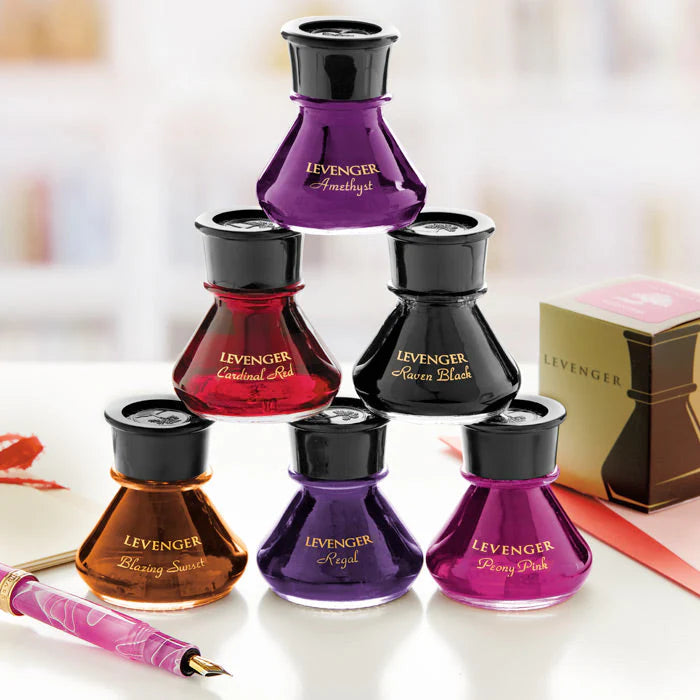
Cartridges win on convenience; bottled ink wins on colour range and cost per page. Beyond that, the right ink turns handwriting into a deliberate practice—part productivity, part personal expression. Use this guide to decide between cartridges and bottled ink, set realistic expectations for drying time, understand sheen, and choose appropriate water resistance for everything from quick notes to archival records.
Cartridges or Bottled Ink? Choose by routine and setting
If your days are packed and you prize clean, quick refills, cartridges keep you moving. If you enjoy color variety, longer writing sessions, and a lower cost per milliliter, bottled ink rewards the ritual. Levenger’s inks are formulated for smooth flow and crisp, business‑ready lines across a wide range of papers.
Practical picks from the Levenger assortment
- Speed and tidiness on busy days: Keep a sleeve of Levenger Ink Cartridges (set of 16) for fast, no‑mess refills. Each cartridge is 0.6 ml with an international end, and Raven Black is noted as water‑resistant while other colors are washable—useful for easy pen care.
- Desk writing and lower long‑term cost: A 50 ml bottle of Levenger Bottled Ink pairs with a converter and includes an in‑bottle inkwell for tidier filling. The lightfast, quick‑drying formula resists feathering and maintains a crisp line, which many left‑handed writers appreciate.
- Permanence for records: When you need document‑friendly performance, consider Graf von Faber‑Castell Fountain Pen Ink in document‑proof formulations for signatures and official copies.
- Palette building without commitment: Explore small bottles like Ferris Wheel Press Superman Fountain Pen Bottled Ink (10 ml) to audition expressive hues and sheen‑friendly colors before you buy a full bottle.
- Cross‑brand cartridge compatibility: Many pens accept standard international cartridges such as Graf von Faber‑Castell Fountain Pen Ink Cartridges. Some brands use proprietary systems—Parker pens take Parker Fountain Pen Ink Cartridges, and Sheaffer pens use Sheaffer Fountain Pen Ink Cartridges (set of 5).
Need help picking or using a converter? See Refills & Converters: Getting the Most from Your Levenger and Partner Brands.
Decision matrix: Which ink format fits your routine?
Use this compact table to match ink format to common priorities.
| Priority | Cartridges | Bottled Ink |
|---|---|---|
| Setup & speed | Fastest—snap in and write; minimal cleanup. | Slower—fill with a converter; brief cleanup rewarded with choice. |
| Cost per ml | Higher over time due to single‑use volumes. | Lower per ml in 50 ml bottles. |
| Color variety | Curated by brand. | Broad palette including special hues/finishes. |
| Portability | Excellent for travel; carry a spare cart. | Best at desk; samples work on the go. |
| Sustainability | Pen is reusable; cartridges are disposable (some writers refill with a syringe). | Glass bottle serves many fills; recyclable and long‑lived. |
Drying time: what truly affects it
Drying time is how long fresh writing can be touched without smudging. Four variables dominate: paper, nib/flow, your technique, and the ink’s chemistry. Levenger inks are engineered to be lightfast, quick‑drying on paper, and resistant to feathering, helping maintain neat, professional lines.
How to write drier (or richer) by design
- Paper choice matters: Ultra‑smooth, coated paper slows absorption and can extend dry time; moderately absorbent paper shortens it. For brand‑specific pairings, visit Paper Compatibility: Which Levenger Papers Love Fountain Pens.
- Nib width and flow: Finer nibs deposit less ink for faster dry times; broader nibs lay more ink for shading and sheen. Explore tradeoffs in Nib Selector: Fine, Medium, Broad—Line, Feedback, and Paper Pairings.
- Technique tips: A light touch and steady pace reduce pooling. If your grip gets tense, the advice in Ergonomics & Balance: Matching Pen Weight and Diameter to Your Grip can help.
- Left‑handed adjustments: Under‑writing posture, slightly drier inks, and finer nibs curb smudges. See Left‑Handed Writing Tips: Smudge Control and Line Choice.
What creates sheen—and how to control it
Sheen is the reflective, sometimes contrasting halo that appears when saturated dye crystals form on the paper surface as heavy strokes dry. You’ll see more sheen with wet pens, slower‑drying paper, and highly saturated inks; you’ll see less with absorbent paper, finer nibs, or quicker‑dry formulas.
Encourage or tame sheen with small tweaks
- To encourage sheen: Use a wetter nib and slower‑drying paper; pause slightly at the end of strokes to build saturation. A clear demonstrator such as the Nahvalur Original Demonstrator Fountain Pen also lets you enjoy ink color in the reservoir.
- To minimize sheen: Choose a finer nib, moderately absorbent paper, and an ink described as quick‑drying—Levenger’s core palette is tuned for crisp, professional results with minimal spread.
- To explore expressive scripts: Try smaller bottles to test how a hue behaves with your paper and nib, then practice with specialty tips—see Calligraphy & Special Nibs: When to Experiment and How to Practice.
Water resistance: when it matters—and simple ways to plan for it
Water resistance safeguards writing against rain, spills, or mail handling. Levenger’s Raven Black is water‑resistant, while many other colors are washable for easy maintenance. Choose permanence for signatures and addresses, and washable colors for journals you update often.
- Everyday journals and class notes: Washable colors are practical and easier to clean from pens and converters.
- Envelopes, forms, and official copies: A water‑resistant black reduces smearing in damp conditions; document‑proof options like Graf von Faber‑Castell Fountain Pen Ink are another route when permanence is paramount.
- Mixed environments: Keep two writers handy—one cheerful color for notes, one water‑resistant black for signatures. A dependable daily pen like the Monteverde Dakota Fountain Pen suits this simple two‑pen setup.
- Monteverde Dakota Fountain Pen — A reliable fountain pen to test water resistance and permanence in real use.
- Graf Von Faber-Castell Fountain Pen Ink (75 ml) — A document‑proof fountain pen ink option for signatures and official documents.
Compatibility and sustainability
Cartridges: Levenger cartridges are standard‑size with an international end, fitting all Levenger fountain pens and many others that accept international cartridges. Proprietary systems (for example, Parker or Sheaffer) require their own cartridges. Bottled ink: Paired with a converter, bottled ink reduces packaging over time and keeps a favorite pen writing for years. For longevity and low‑waste strategies, see Sustainable Writing: Refill Strategies and Care for Decades of Use and the cleaning guidance in Maintenance Rituals: Cleaning, Flushing, and Safe Storage.
- Lamy Z24 Fountain Pen Converter — Use a converter to fill bottled ink, cutting cartridge waste and broadening color choices.
Real‑world setups
- Office and client work: Choose a medium nib with Levenger Bottled Ink in a classic business blue or water‑resistant Raven Black for signing and annotation. If you enjoy seeing ink levels as you work, a demonstrator like the Nahvalur Original Demonstrator Fountain Pen is satisfying at the desk.
- Campus or workshop: Tuck Levenger Ink Cartridges in your pouch for quick color swaps between classes. A value‑savvy writer that still feels refined is the Conklin LEX Fountain Pen.
- Creative sketchbook: Load saturated hues to experiment with sheen and shading. Small formats such as Ferris Wheel Press 10 ml bottles make low‑risk studies easy.
- Travel days: Cartridges simplify airport security and fast refills. For leak‑prevention tips and carry options, see Traveling with Pens: Flying, Leaks, and Everyday Carry.
- Conklin Lex Fountain Pen — A professional fountain pen recommended for office setups and everyday medium‑nib work.
Further reading for confident choices
Ink is only part of the equation. If you’re selecting a daily writer or building a thoughtful collection, you may also enjoy Choosing Your Everyday Writer: Ballpoint vs. Rollerball vs. Fountain, Starter to Collector: Building a Capsule Pen Collection, and the model‑specific overview in True Writer Buyer’s Guide: Bodies, Nibs, Finishes, and Interchangeable Options. For presentation ideas and workspace inspiration, see Presentation Matters: Cases, Stands, and Desk Display Ideas.
Frequently Asked Questions
Are Levenger cartridges “standard international” size?
Yes. They’re a standard size with an international end and fit all Levenger fountain pens—and many others that accept international cartridges. Pens with proprietary systems (e.g., Parker or Sheaffer) use their brand’s cartridges.
What’s the quickest way to reduce smudging?
Combine a finer nib with a quick‑drying ink, write with a light touch, and choose a moderately absorbent paper. For paper suggestions, see Paper Compatibility: Which Levenger Papers Love Fountain Pens.
Is water‑resistant ink safe for my pen?
Used normally with routine cleaning, yes. Levenger’s Raven Black is water‑resistant for addressing and records, while most other colors are washable for easy maintenance. Clean your pen every few fills—simple steps are outlined in Maintenance Rituals: Cleaning, Flushing, and Safe Storage.
My ink looks lighter/darker than expected. What changed?
Paper, nib width, and flow can shift how a color appears. Smoother paper and wetter nibs deepen saturation and can increase sheen; absorbent paper and finer nibs lighten the look. For on‑page troubleshooting, try the diagnostics in Troubleshooting Flow: Skips, Hard Starts, and Scratchiness.
Next steps
If you write mostly on the go, start with cartridges and a fine nib for quick drying. If you write at a desk and want color range and value, choose bottled ink with a converter. Levenger’s inks and pens are designed to last, and the rewards program makes replenishing surprisingly cost‑effective over time. When you’re ready to experiment, explore nibs and specialty scripts, protect your tools with mindful care, and enjoy the daily practice—pen, paper, and ink working in harmony.
- Levenger Ink Cartridges (set of 16) — Standard Levenger cartridges for quick, on‑the‑go refills and easy swaps.
- Levenger Bottled Ink — Bottled ink for desk use and greater color range when paired with a converter.


