
Clean a fountain pen with a quick rinse every week or two, and flush it until the water runs clear each time you change inks. This guide refines a repeatable routine—how to clean and flush your fountain pens (and tidy up other formats), prevent stains, and store instruments safely at your desk, at home, and in transit. Where it helps, we’ll point to thoughtful Levenger tools that make the ritual simpler and more enjoyable.
Your Core Kit: Simple Tools That Make Care Enjoyable
Set aside a small, dedicated space so maintenance feels like a ritual rather than a chore. A lidded tray or compact case keeps everything together between sessions. Many writers prefer a tidy workstation such as the velvet‑lined Fountain Pen Studio for organizing bottles, converters, and spare nibs. If you enjoy seeing your favorites at a glance, the slim leather Clearview Pen Porter cradles daily writers while protecting them from ink transfer and scuffs.
- Water: Room‑temperature, preferably distilled if you have hard water.
- Soft, lint‑free cloths: Cotton or microfiber for drying and blotting nibs.
- Bulb syringe or converter: For controlled flushes through the feed.
- Neutral cleaner for stains (off paper): Keep Amodex Ink Remover nearby for hands, desks, and many fabrics.
- Protective storage: A structured organizer like the zip‑secure Leather Pen Folio or a durable fabric carry such as the Canvas Pen Pouch.
Value tip for U.S. readers: watch seasonal promotions and consider joining Levenger Rewards. Members often earn points on refills and care tools—useful for building a small maintenance kit over time.
- Fountain Pen Studio — A velvet-lined lidded organizer designed for bottles, converters, and spare nibs, keeping tools tidy and visible.
- Clearview Pen Porter — Slim leather carrier with a clear window to display daily pens while protecting finishes and preventing ink transfer.
- Amodex Ink Remover Kit — A small kit for removing dried or fresh ink from tools and surfaces during maintenance sessions.
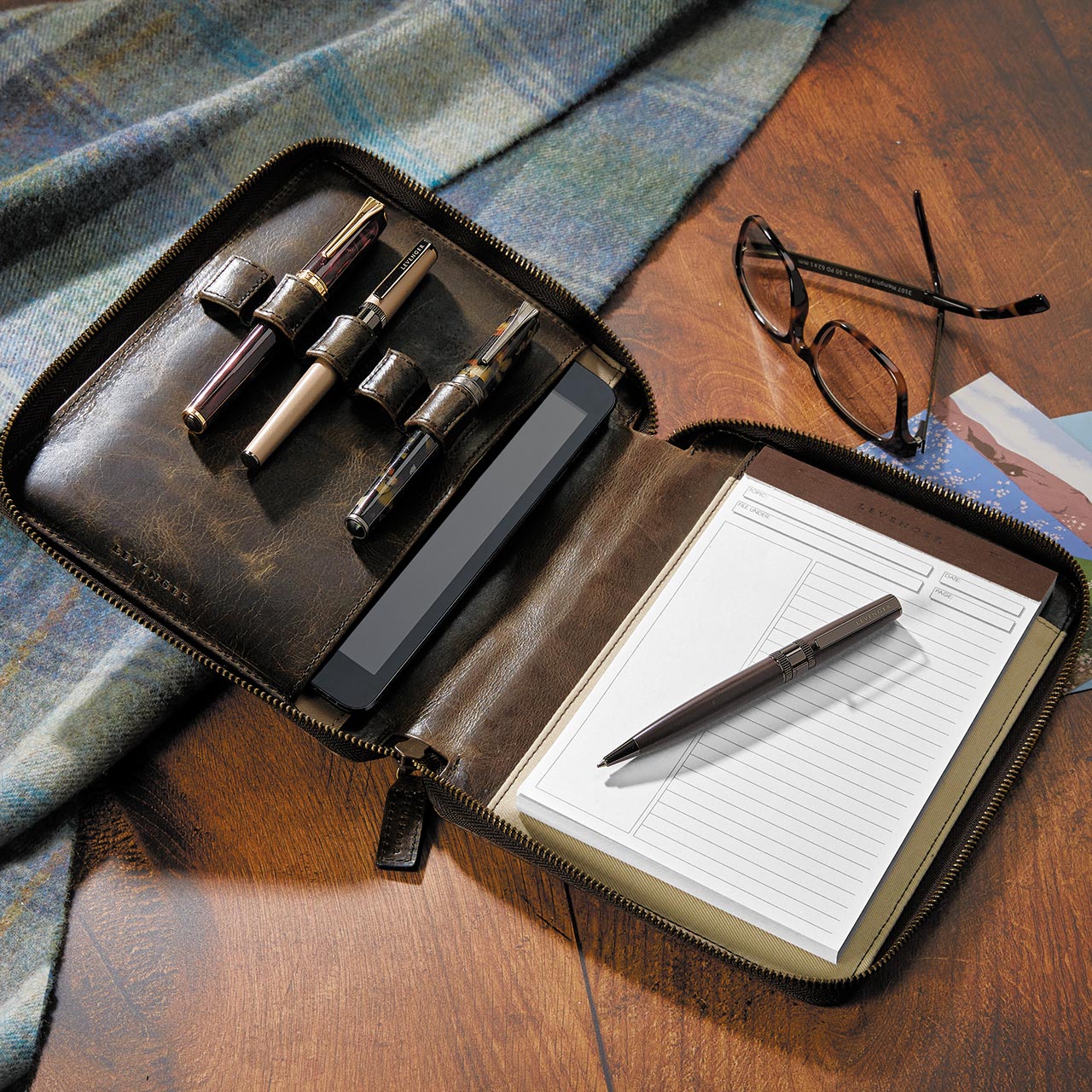
- Leather Pen Folio — Structured leather folio that stores pens and small accessories safely between cleanings.
- Canvas Pen Pouch — A soft, zippered canvas pouch for corralling cloths, converters, and spare cartridges in one compact place.
Cleaning vs. Flushing: What’s the Difference?
Cleaning is light routine maintenance—rinsing ink residue and wiping the nib and section. Flushing moves water through the feed until it runs clear, typically using a converter or bulb syringe. Flush whenever you change ink colors, after heavy use, or if you notice skipping or hard starts. For ink behavior and drying characteristics, see Ink 101: Cartridges vs. Bottled, Drying Time, Sheen, and Water Resistance.
Routine Schedule (U.S. climates in mind)
- Every 1–2 weeks (daily fountain pen): Quick rinse and blot. In arid regions like the Southwest, add an occasional overnight nib soak to counter faster evaporation.
- At every ink change: Full flush until water runs clear. If switching from a highly saturated or shimmering ink, perform a second flush after a short soak.
- Before storage of 2+ weeks: Empty the pen and flush; let parts dry fully before capping.
- Cold‑weather note: In northern climates, avoid leaving inked pens in vehicles where freezing can damage feeds and sacs.
If flow issues linger after a proper flush, walk through the checkpoints in Troubleshooting Flow: Skips, Hard Starts, and Scratchiness.
Step‑by‑Step: Quick Clean for Cartridge/Converter Pens
- Disassemble: Uncap, remove the cartridge or converter, and keep the nib section in hand.
- Rinse: Run a thin stream of water over the nib and feed; roll the nib on a cloth to wick ink.
- Converter assist: Fill and expel clean water through the nib several times using the converter.
- Dry: Stand the nib section nib‑down on a cloth for 15–30 minutes; reassemble once just damp.
For parts, compatibility, and alternatives (piston, vac, eyedropper), see Refills & Converters: Getting the Most from Your Levenger and Partner Brands.
Deep Flush: When You’re Changing Inks or Reviving a Pen
- Prepare water: Room‑temp. If your tap water is very hard, use distilled to reduce mineral deposits.
- Cycle flushes: Use your converter or a bulb syringe to draw and expel clean water until the output is nearly clear.
- Soak (optional): Leave the nib section in a cup of clean water for 2–8 hours; replace the water if it tints.
- Final rinse and dry: One last flush, then air‑dry nib‑down on a cloth. Avoid heat and direct sun.
Curious how nib width influences cleaning frequency and ink choice? Explore Nib Selector: Fine, Medium, Broad—Line, Feedback, and Paper Pairings.
Care for Non‑Fountain Pens
- Rollerball: Store capped; wipe the tip with a soft cloth if buildup occurs. Replace refills promptly if skipping persists.
- Ballpoint: If a blob forms, scribble on scrap paper and clean the tip with a lightly damp cloth.
- Felt/Fineliners: Keep capped and horizontal; avoid rough paper that accelerates tip wear.
Paper matters for both longevity and feel—pair inks and nibs with smooth, fountain‑pen‑friendly sheets as outlined in Paper Compatibility: Which Levenger Papers Love Fountain Pens.
Decision Matrix: Cleaning Approaches by Pen Type
Use the compact table below to choose the right method for today’s task.
| Pen Type | How Often | Primary Method | Notes & Cautions |
|---|---|---|---|
| Cartridge/Converter Fountain Pen | Rinse weekly; flush at ink change | Converter flush through nib/feed | Dry nib‑down; avoid soaps and alcohol. |
| Piston/Vac Fountain Pen | Flush at color change or monthly | Fill/expel clean water several times | Do not disassemble beyond maker guidance. |
| Disposable Fountain Pen | Wipe nib as needed | Light rinse only | Designed for convenience; no deep flush required. |
| Rollerball | As needed | Wipe tip; replace refill | Keep capped to prevent drying. |
| Ballpoint/Felt | As needed | Wipe tip | Avoid pressure that flattens tips. |
Safe Storage: Desk, Home, and Travel
On the desk
Keep in‑use fountain pens either horizontal or nib‑up to reduce nib dry‑out. If you prefer a visible, compact setup, the windowed Clearview Pen Porter displays and protects a small daily rotation while keeping a cloth or spare cartridges handy. For display ideas that keep finishes protected, see Presentation Matters: Cases, Stands, and Desk Display Ideas.
At home
Store cleaned pens in a structured organizer that shields clips and finishes. A leather case such as the four‑loop Leather Pen Folio works for a focused rotation; for a small suite of tools and a notebook, a durable fabric carry like the Canvas Pen Pouch adds pockets for refills and cards.
On the road
Travel amplifies bumps and pressure changes. Before flying, either fill a fountain pen fully or travel with it empty to minimize leaks, then keep it nib‑up in a structured case. For flight‑specific tips and everyday carry, see Traveling with Pens: Flying, Leaks, and Everyday Carry.
- Point of View Pen Case — Structured zip case sized for safe transport and nib-up storage while traveling.
- True Writer Pen Box — A lined pen box built to cradle pens horizontally and protect finishes on the desk or in transit.
- Leather Add-A-Pen Pouch — A slim leather pouch that adds protection and prevents pens from rolling or contacting other items.
Ink Stains: Clean Hands, Desks, and Fabrics
Act quickly: blot, don’t rub. For non‑porous surfaces and many fabrics, a small amount of Amodex Ink Remover helps lift fresh ink safely. Always spot‑test on an inconspicuous area and follow garment care labels.
Choosing Low‑Maintenance Setups
If you want fewer cleanings, choose a well‑behaved ink, avoid shimmer for everyday office notes, and keep a simple backup writer. For an easy starter that makes color changes straightforward, the balanced cartridge/converter system in the True Writer Golden Dark Tortoise Fountain Pen Kit simplifies flushing between inks. Prefer a coordinated pen‑and‑ink ensemble for your desk set? Consider a curated pairing like the Pelikan M200 Apricot Fountain Pen Gift Set or the Ferris Wheel Press Superman Fountain Pen and Ink Set—both align bottle and nib sensibly for predictable flow.
If you split your time between fountain pen and ballpoint or rollerball, a compact duo such as the Faber‑Castell Poly Fountain Pen and Ballpoint Gift Set or the grippy, student‑friendly Faber‑Castell Sky Blue Grip Pen Gift Set can keep maintenance light while covering every meeting and margin note. For long‑term ownership and refilling strategies that save money and reduce waste, see Sustainable Writing: Refill Strategies and Care for Decades of Use.
- True Writer Golden Dark Tortoise Fountain Pen Kit — Balanced cartridge/converter kit that simplifies flushing and makes ink swaps straightforward.
- Pelikan M200 Apricot Fountain Pen Gift Set — A well-behaved fountain pen gift set with predictable flow for fewer maintenance needs.
- Faber-Castell Poly Fountain Pen and Ballpoint Gift Set — A coordinated pen-and-accessory set useful for a desk pairing that reduces surprise maintenance.
- Faber-Castell Sky Blue Grip Pen Gift Set — A reliable writing set option for everyday use that keeps refill and handling simple.
- Pilot Varsity Fountain Pen Gift Set — A disposable cartridge-based pen set that minimizes cleaning and makes ink changes easy.
- Lamy Z24 Fountain Pen Converter — A spare converter for easy cartridge-to-bottle switching without needing a full overhaul.
Common Mistakes to Avoid
- Using alcohol or household solvents: These can damage feeds and finishes.
- Skipping dry time: Trapped water dilutes ink and invites drips. Let parts air‑dry before reassembly.
- Over‑tightening caps and sections: Compresses seals and risks cracking; snug is enough.
- Leaving pens inked and idle for weeks: Pigments concentrate; flush before storage.
Frequently Asked Questions
How often should I flush if I use my fountain pen every day?
Do a quick rinse weekly and a full flush at each color change. If you stick with one conservative ink, a monthly flush usually suffices.
Can I clean a piston‑fill pen without disassembling it?
Yes. Fill and expel clean water repeatedly through the nib until it runs clear. Avoid taking the mechanism apart unless the maker provides instructions.
What’s the safest way to travel with an inked fountain pen?
Before flights, either fill the reservoir completely or empty and flush, then store nib‑up in a structured case. Keep a simple ballpoint or rollerball as a backup for quick notes. For format pros and cons, compare options in Choosing Your Everyday Writer: Ballpoint vs. Rollerball vs. Fountain.
Do I need special soap or chemicals to flush a pen?
No. Clean, room‑temperature water is the default. Use distilled water if yours is hard. Avoid alcohol and household cleaners; for stains on surfaces and many fabrics, choose a purpose‑made option like Amodex Ink Remover and always spot‑test first.
Next Steps
Build a simple, sustainable care ritual that suits your writing life. If you’re exploring specialty nibs that may require more deliberate cleaning, see Calligraphy & Special Nibs: When to Experiment and How to Practice. To fine‑tune comfort and reduce fatigue during longer sessions, visit Ergonomics & Balance: Matching Pen Weight and Diameter to Your Grip. And if you’re thinking about curating a small rotation that’s easy to maintain, explore Starter to Collector: Building a Capsule Pen Collection for thoughtful approaches on a range of budgets—Levenger often offers strong values and member deals without compromising quality.


