
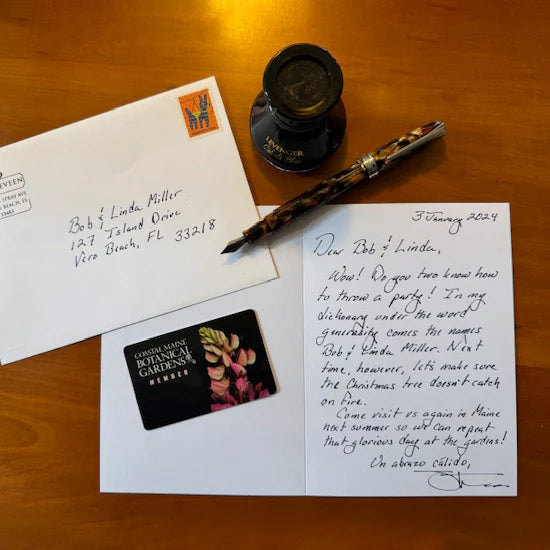
Fine, medium, and broad are the nib sizes that change the line, the feel, and how fast the ink dries. This guide translates fine, medium, and broad into practical choices—how wide the line appears, how smooth or tactile the feedback feels, how quickly ink dries on common U.S. papers, and which Levenger options make swapping sizes simple.
Quick answer: which nib fits your goal?
- Fine (about 0.6 mm): Crisp notes in tight spaces, margin edits, small handwriting, and everyday carry on mixed paper. To try fine without buying a new pen, start with the interchangeable True Writer Nib.
- Medium (about 0.8 mm): Balanced line with easy flow that works for most meetings, journaling, and correspondence. Prefer warm trim? The Levenger Bi-Color Steel Nib offers the same sizes with a gold-accented look.
- Broad (about 1.0 mm): Expressive signatures and headers, rich shading, and relaxed journaling on premium paper. For a modern aesthetic, choose the True Writer Stealth Black Nib in broad.
If you own a larger True Writer Select, use the dedicated True Writer Select Fountain Pen Nib—it fits Select models only.
- True Writer Nib — Interchangeable True Writer nib to try a fine without buying a new pen, matching the section’s suggestion.
- Levenger Bi-Color Steel Nib — Two-tone steel True Writer nib option available in fine size for a refined look with the same sizing.
- True Writer Stealth Black Nib — Stealth black True Writer nib offered in fine to match a modern aesthetic while providing a crisp line.
- True Writer Select Fountain Pen Nib — Select-format True Writer nib in fine size for those who prefer the larger Select bodies but want a fine line.
- Monteverde Dakota Air Force Fountain Pen — A compact fountain pen option that provides a true fine tip for crisp notes and small handwriting on mixed paper.
The fine–medium–broad decision matrix
Use this compact table to compare how each size behaves across real‑world priorities.
| Priority | Fine (~0.6 mm) | Medium (~0.8 mm) | Broad (~1.0 mm) |
|---|---|---|---|
| Legibility in small spaces | Excellent—precise characters on narrow ruling | Good—balanced shape and weight | Fair—can crowd tight rulings |
| Writing feel (feedback) | More tactile control on most papers | Smooth with a hint of grip | Glassy‑smooth on quality paper |
| Dry time on office copy paper | Fastest | Moderate | Slowest |
| Ink shading & sheen potential | Low–moderate | Moderate | High |
| Signature presence | Subtle | Confident | Bold and expressive |
| Paper sensitivity (bleed/show‑through) | Lowest risk | Balanced | Highest—prefers premium paper |
Line width and handwriting style
Nib width and your natural stroke size work together. If your handwriting is compact or you annotate in the margins, fine preserves letter shapes. If your script breathes with medium letterforms, medium often reads best at arm’s length in meetings. Broad rewards larger, rounded scripts and unhurried journaling with visible ink character.
True Writer fountain pens accept interchangeable units, so you can size your line to the task instead of committing to a single width. Explore timeless bodies like the warmly finished True Writer Classic Cafe Mocha Fountain Pen or the heritage look of the True Writer Classic Golden Dark Tortoise Fountain Pen, then match the nib that fits today’s page. For a model overview, see True Writer Buyer’s Guide: Bodies, Nibs, Finishes, and Interchangeable Options.
Feedback and smoothness: what you’ll feel on the page
“Feedback” is the tactile sensation as the iridium‑tipped point meets paper. Fine usually feels a touch more textured, which many professionals appreciate for control on fast notes. Medium keeps a pleasing balance—smooth but not skittish. Broad can feel like skating on good paper, especially with well‑lubricated inks. If your hand is sensitive to micro‑vibrations, start at medium; if you crave absolute glide on premium paper, try broad.
Comfort also comes from balance and grip. If you’re optimizing for fatigue-free sessions, pair this with Ergonomics & Balance: Matching Pen Weight and Diameter to Your Grip.
Ink behavior: flow, dry time, and refill strategy
Broader nibs lay more ink, which enhances shading but lengthens dry time; finer nibs use less ink and help minimize feathering on everyday copy paper. On U.S. letter paper at the office, a fine or medium with a reasonably quick‑drying ink is the most forgiving combination. If you enjoy expressive inks, keep a broader nib ready for premium paper at home.
For practical advice on cartridges vs. bottled ink, drying time, and water resistance, see Ink 101: Cartridges vs. Bottled, Drying Time, Sheen, and Water Resistance and Refills & Converters: Getting the Most from Your Levenger and Partner Brands.
Paper pairings that flatter each nib
Paper finish and weight influence how lines appear. On smoother, heavier sheets you’ll see more sheen and a crisp edge—ideal for medium and broad. On everyday copier paper, a fine or medium reduces feathering and show‑through. If you keep a Circa or Freeleaf setup for work, reserve your most fountain‑pen‑friendly refills for expressive inks and broader nibs.
For brand‑specific matches and page sizes—from Junior to Letter—consult Paper Compatibility: Which Levenger Papers Love Fountain Pens.
Scenario‑based recommendations
- Small‑ruled notebooks and fast note‑taking: Fine. If you want a smoother feel, try medium with a slightly drier ink.
- Client signatures and thank‑you notes: Broad on premium paper shows off shading and visual presence; choose medium if you value quicker dry times for hand‑addressed envelopes.
- Everyday office mix (agendas, printouts, forms): Medium for versatility; fine if your copier paper is prone to feathering.
- Left‑handed, especially overwriters: Fine or a faster‑drying medium, plus mindful hand position. For practical technique, see Left‑Handed Writing Tips: Smudge Control and Line Choice.
Why Levenger for nib selection?
- Interchangeability by design: True Writer fountain pens are built so you can unscrew and swap nib units in minutes—ideal for shifting from margin notes to bold signatures without buying a second pen.
- Consistent line widths: Levenger’s German‑engineered, iridium‑tipped steel nibs are offered in clearly defined sizes—approximately 0.6 mm (fine), 0.8 mm (medium), and 1.0 mm (broad)—to set accurate expectations across papers.
- Thoughtful value: Levenger balances craftsmanship with affordability—interchangeable nibs are often a more cost‑effective way to change your writing experience, and there are frequent promotions. Regular writers also appreciate the Loyalty program for ongoing savings.
- True Writer Classic Obsidian Pen — A True Writer Classic pen body that accepts interchangeable nib units, letting you swap sizes without buying another pen.
How to switch sizes safely
- Flush the pen if you’re changing ink color or switching between very different flows.
- Unscrew the existing nib unit gently; align and seat the replacement snugly—do not overtighten.
- Prime the feed with a few gentle strokes on scrap paper; if flow hesitates, give the cartridge or converter a light tap to encourage saturation.
For long‑term care, see Maintenance Rituals: Cleaning, Flushing, and Safe Storage. If your pen suddenly feels dry or scratchy after a swap, visit Troubleshooting Flow: Skips, Hard Starts, and Scratchiness.
Levenger nib and pen options to consider
- Core interchangeable unit: The stainless‑steel, iridium‑tipped True Writer Nib comes in fine, medium, and broad—an easy first upgrade for any True Writer Classic.
- Two‑tone look: Choose the Levenger Bi‑Color Steel Nib to complement gold‑trim pens while keeping the same size options.
- Stealth aesthetic: Prefer monochrome hardware? The True Writer Stealth Black Nib offers fine, medium, and broad in a lacquered black finish.
- For Select bodies only: Owners of True Writer Select should choose the True Writer Select Fountain Pen Nib, designed for that larger format.
- Ready-to-write pen with room to grow: The True Writer Classic Cafe Mocha Fountain Pen pairs comfortably with any size and welcomes future nib swaps as your style evolves.
- Classic presence for signatures: The True Writer Classic Golden Dark Tortoise Fountain Pen is often favored for medium and broad lines in formal correspondence.
- A bundled way to experiment: If you want a complete setup with ink and converter for comparing nibs at home, the True Writer Golden Dark Tortoise Fountain Pen Kit is a convenient starting point.
- Color-forward journaling: The True Writer Classic Green Grotto Fountain Pen flatters shading inks—pair it with a medium or broad for relaxed pages.
- True Writer Golden Dark Tortoise Fountain Pen Kit — Ready-to-write True Writer fountain pen kit in a warm tortoise finish, representing a full pen option that accepts interchangeable nibs.
- True Writer Classic Green Grotto Fountain Pen — Classic Green Grotto fountain pen offering a ready pen option that pairs with fine, medium, or broad True Writer nibs.
- True Writer Classic Carrara Fountain Pen — A Carrara-pattern True Writer Classic fountain pen as a clear, stylish ready-to-write option in selectable nib sizes.
- True Writer Classic Twilight Storm Fountain Pen — Twilight Storm True Writer Classic fountain pen to show another ready-to-write model available in fine, medium, or broad.
Next steps
If you’re still between sizes, choose medium now—then add a fine or broad nib so you can compare on your favorite paper at your own desk. For everyday format decisions (ballpoint vs. rollerball vs. fountain), see Choosing Your Everyday Writer: Ballpoint vs. Rollerball vs. Fountain. When you’re ready to experiment with italics and stubs for headers and invitations, read Calligraphy & Special Nibs: When to Experiment and How to Practice.
Frequently Asked Questions
How much wider is medium than fine in real use?
On typical U.S. office paper, medium produces a rounder, slightly bolder character than fine. If your handwriting is small or you prefer narrow ruling, fine usually preserves clarity; for mixed tasks, medium is the read‑anywhere choice.
Will a finer nib always write drier and a broader nib always write wetter?
Generally yes—finer points deposit less ink and feel drier, while broader nibs lay more ink and feel wetter. Ink chemistry and paper finish can narrow or widen that gap. If dry time is your top priority, combine a fine or medium nib with a faster‑drying ink and smoother paper.
Can I change nib sizes on a True Writer without sending the pen in?
Yes. True Writer nib units are user‑swappable—unscrew the old unit, screw in the new one, prime, and write. If you own a True Writer Select, use its dedicated Select nib. For step‑by‑step care, visit Maintenance Rituals: Cleaning, Flushing, and Safe Storage.
Which nib size is best for signatures on premium letter paper?
Broad offers the most presence and reveals shading and sheen on high‑quality paper. If you need faster drying for document handling, medium is a strong compromise that still looks confident.


