
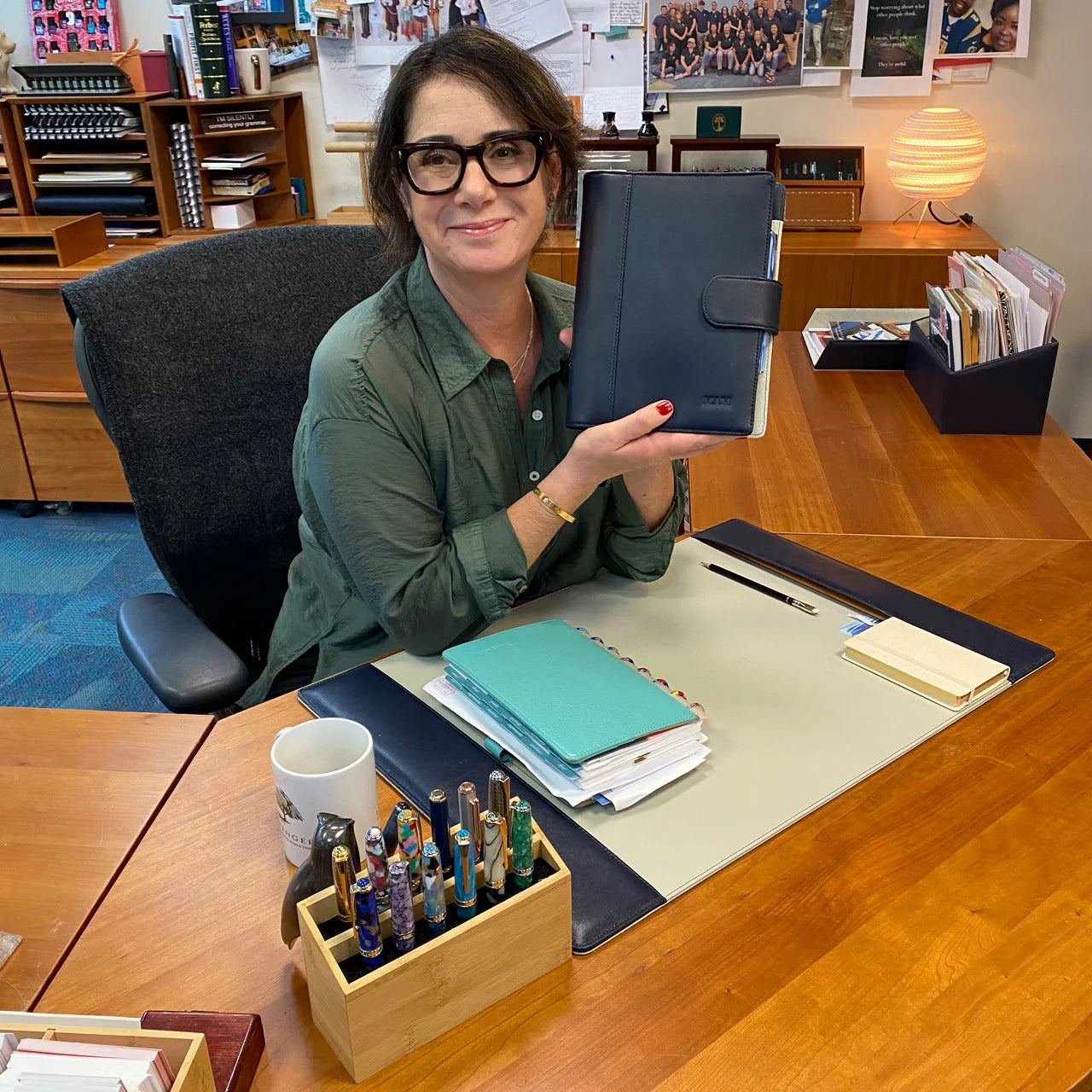
A well‑chosen planner is more than paper. It’s a quiet operating system for your time, attention, and commitments—one you can refine as your life changes. This Core Guide brings together what shoppers most often ask us to compare: monthly, weekly, and daily layouts; portable sizes versus desk‑friendly pages; the flexibility of discbound systems; when to invest in leather or personalization; and how to build a first planner that doesn’t become clutter. Throughout, you’ll find practical use cases for work, teaching, and family life, with clear links to deeper resources where a few more details can save you years of trial and error.
Planners and agendas, in real‑world terms
People use different words—planner, agenda, calendar, notebook—to mean almost the same thing: a trusted place to see what’s next and capture what matters. In practice, most buyers want to solve four jobs:
- See the right horizon at a glance—month, week, or day—without flipping endlessly.
- Record time‑specific appointments alongside tasks and quick notes.
- Carry only what’s needed and archive the rest, so the book stays light but complete.
- Look polished in meetings and stand up to daily use from January to December.
If your current setup struggles on any of these, the fix usually lives in layout, size, or system flexibility. We’ll tackle each in turn, then close with a scannable set of takeaways and an FAQ.
Start with layout: the view that matches how you think time
Layout is the single choice that most affects day‑to‑day usability. Some brains think in months; others in weeks or tightly scheduled days. A quick litmus test: what do you open first on a Monday morning? If your instinct is the month spread for seasonal cues and travel windows, start monthly. If you immediately block a week’s priorities, you’re a weekly thinker. If your calendar runs by the hour and meetings shift often, you’re likely a daily planner at heart. For a deeper side‑by‑side—including how to mix horizons without duplicating work—see Monthly vs Weekly Planner Layout: Which Should You Buy?.
The most resilient systems pair horizons. Professionals often keep a monthly for forecasting six to eight weeks out, run the week for execution, and add daily pages only on meeting‑dense days. A modular, discbound planner makes that blend effortless.
Weekly and monthly agendas that anchor a working planner
Start with the agenda pages you’ll read every day. The first row below highlights weekly and monthly mainstays that form the heart of most systems. Choose the horizon that fits your appointment load, then add support pages as needed.
- A weekly canvas that balances appointments and priorities: 2027 Circa Modern smartPlanner Weekly Agenda Notebook — it delivers a dated, week‑at‑a‑glance structure with room for outcomes and notes, bound by discs so you can archive by month while keeping carry weight low.
- Start any month you decide to get organized: Circa Start‑Anytime Visions smartPlanner Agenda Refill — it lets you begin today, then add or remove months as projects intensify or ease.
- Long‑range visibility with minimal daily detail: 2027–2028 Circa Sunday Start 2‑Year Monthly Agenda spans two full years for travel, fiscal deadlines, and team calendars, while leaving your weekly pages to handle execution.
- Prefer a classic monthly in Junior or Letter: 2027–2028 Circa 2‑Year Monthly Agenda, Junior — it gives a compact footprint for everyday carry with a clean grid and notes space that resists crowding.
- A weekly rhythm you can rebuild each season: 2027 Circa Modern smartPlanner Weekly Discbound Refill refreshes your book without replacing your cover, keeping costs predictable across the year.
- When you want a traditional Sunday‑start weekly view: 2027 Circa Sunday Start Weekly Agenda Refill provides classic horizontal weeks for roles that plan weekends with intention.
Choose a size that matches your bag and your writing
Size is practical first, expressive second. The right page is the one you can carry and actually write on. In the U.S., working sizes include Compact (3 3/4 × 6 3/4 in), Junior (5 1/2 × 8 1/2 in), Midway (about 7 × 9 1/4 in), and Letter (8 1/2 × 11 in). If your day moves between rooms with a laptop bag, Junior is the everyday default; if you park at a desk with printouts, Letter earns its footprint; if you teach or coach and need a wider canvas without the bulk of Letter, Midway is a thoughtful middle; if you need a pocket companion for travel or lists, Compact fits where other books don’t. For measured guidance that compares disc counts and what comfortably fits in each form factor, see Planner Sizes Explained: Which One to Carry Daily.
Notebook covers that make size frictionless
A durable cover is the difference between a tool you baby and one you carry everywhere. Choose materials and formats that suit the way you move—smooth leather that looks at home in a boardroom, or translucent poly for lightness. Pick the size you’ll actually take to meetings 80% of the time, then add capacity with larger discs only if your weeks demand it.
- Leather presence that still travels easily: Circa Luxe Leather Discbound Notebook — it offers full‑grain refinement with a foldover design that protects pages in Junior, Midway, or Letter.
- Lightweight durability for students and commuters: Circa Translucent Discbound Notebook Covers (set of 2) keep weight down while giving you a clean, modern profile in any size.
System matters: why discbound often wins for working adults
There’s a reason seasoned planners gravitate toward discs: it’s the rare format that behaves like a notebook when you’re capturing notes, like a binder when you’re rearranging, and like a bound planner when you’re in a meeting. You can move pages between months or roles, add reference sheets, and archive cleanly when projects end. If you’re assembling from scratch—or you’ve outgrown a one‑piece annual book—a modular setup earns its keep across multiple years. When you’re ready for a step‑by‑step build (size, paper, dividers, what to add now and what to skip), this primer will save you from over‑building: What to Put in Your First Planner.
Essentials for a first, confidence‑building setup
Start light. Prove the habit with one horizon (weekly or monthly), 60–100 sheets, 3–4 tabs, and an inbox pocket. Only then add specialty pages or a punch. Keep friction low and writing feel high; the right paper weight makes you want to use the tool.
- The simplest way to begin without guessing inserts: Circa Discbound Notebook Starter Kit — it provides discs, covers, and essential pages so you can start planning in minutes, then customize once you see what you actually use.
- Clean navigation through your week: Circa Discbound Notebook Page Finder (set of 2) — it gives you quick access to Today and Projects without dog‑earing or shuffling tabs.
- Upgrade writing feel from day one: Circa Weekly Freeform Planner Discbound Refill offers a flexible weekly view with generous note space that supports both appointments and project clusters.
- Protection and transparency for handouts and receipts: Circa Clear Discbound Notebook Pocket Dividers corral loose items while keeping them visible, so follow‑ups don’t vanish.
Match the planner to your roles: work, teaching, and family
Most lives run on more than one rhythm. The page that’s perfect for a budget review may not be ideal for lesson plans or a sales pipeline. Before you pick products, decide how many planners you truly need—and where a shared surface helps. For help drawing those lines, with examples for a one‑book/two‑zone approach, a two‑planner split, or a household calendar beside a personal planner, see Choosing a Planner for Work, Teaching or a Busy Family.
Role‑based builds you can put to work this week
Below are proven configurations for common roles. Each list names a practical first purchase you can add to an existing Circa, or build a new book around if you’re starting fresh.
- Client‑facing weeks with shifting meetings: Circa Daily‑Weekly‑Monthly Planner Refill blends horizons so you can pivot from a bird’s‑eye to day‑by‑day without juggling separate books.
- Teacher planning with room for notes and grading cues: 2027 Special Request Circa Weekly Agenda Refill — it supports multi‑section weeks; insert dot‑grid or annotation‑ruled sheets between class blocks as needed.
- Busy family alignment in a shared spot: Weekly Margin Calendar gives a big‑picture week with space for meal plans, assignments, or packing lists where everyone can see them.
- Desk‑side weekly for hybrid work: Weekly Scheduler Freeleaf Pad (set of 2) lives beside a laptop for quick capture; archive snapshots monthly to keep a lean record.
Paper, pens, and the feel of writing
Paper quality is the unsung hero of a calm planning experience. If your notes feather or show through, you’ll write tentatively and use the planner less. Heavier, smoother sheets better support rollerball and fountain‑pen inks, especially in daily layouts where you annotate all day. If you’re curious what a higher budget tangibly buys—paper weight and finish, cover construction, and the longevity of a modular system—see How Much Should You Spend on a Planner?.
Refills and tools that respect your pens
Choose formats you’ll reach for every day and ink that won’t disappoint on premium paper. The cards below are enduring favorites for writing clarity, pace, and line feel.
- Daily structure for meeting‑dense roles: Circa Daily Agenda Refill allocates time blocks, to‑dos, and a generous notes field so follow‑ups stay visible.
- Color‑forward days for faster visual scanning: Circa Vibrant Daily Planner Refill (366 sheets) uses clear, high‑contrast layout cues that make priorities pop.
- High‑capacity task capture you can sort later: Circa Things To Do Discbound Refill (100 sheets) — it keeps running lists tidy and movable between projects.
- Dependable ink flow across your week: Levenger Safety Ceramic Rollerball Refills (set of 6) pair smoothly with premium planner paper to prevent feathering and skipping.
Budget with confidence: what each tier actually buys
U.S. planner pricing spans roughly $10 to $300. As you step up, you’re paying for thicker, smoother paper; modular systems you rebuild each year; and covers that last for years—not months. The goal is to choose once and use often. For a full framework with real‑world tradeoffs and ways to save (including stacking Levenger Rewards with Sale and Clearance), read How Much Should You Spend on a Planner?. Below is a quick, shoppable version.
Under $50: try formats and start the habit
Entry‑tier choices help you test horizons without over‑committing. Expect undated desk pads or a basic discbound start you can grow later. Typical spends in this tier range from $11.50 to $49.95.
- Lightest way to explore daily, weekly, and monthly views: Daily‑Weekly‑Monthly Planner Pad Trio offers three horizons you can lay beside a laptop and recycle guilt‑free.
- A modular foothold you won’t outgrow: Circa Discbound Notebook Starter Kit gets you onto discs for $21.50–$26.50 (USD), with covers and pages you can keep upgrading.
- Fountain‑pen‑friendly handwriting practice that becomes capture: Circa Jotlet Full‑Page Ruled Refill (100 sheets) turns a pocket jotter into a durable list companion.
- A signature pen that feels premium without the premium price: True Writer Classic Il Paradiso Pen — it delivers smooth, reliable lines at $49.95 (USD) and looks at home beside a leather cover.
$50–$120: durable covers and daily‑use upgrades
Mid‑tier spending elevates carry and writing experience: better materials, more capacity, and tools that speed navigation. Typical spends here range from $59.50 to $99.50 (USD) for planners and everyday accessories.
- A slim, professional notebook you’ll actually carry: Circa Smooth Sliver Discbound Notebook with Pockets — it brings sleek protection and card storage for $49.50–$69.50 (USD), making it a refined daily companion.
- A weekly desk‑side canvas for hybrid schedules: Weekly Scheduler Freeleaf Pad (set of 2) — it keeps priorities visible without committing to a bound format.
- A compact leather folio for meeting notes and cards: Emerson True Notes Folio — it adds polish and organization at $79.50 (USD), pairing naturally with Junior planners.
- Everyday professionalism that doubles as a wallet: Carrie Mini Convertible Crossbody Wallet streamlines carry at $99.50 (USD) when you travel light between client sites.
$120 and above: longevity, leather, and high‑capacity systems
At the top tier you’re buying time saved and a look that endures. Expect full‑grain covers, zip folios that secure devices, and writing instruments you’ll keep for years. Typical spends begin around $129.50 (USD) and climb past $200 (USD) for premium pens and leather.
- A travel‑secure home for your planner and tablet: Bomber Jacket Circa Zip Pro Folio — it protects a Junior or Letter Circa with full‑grain leather and organizational pockets for $169.50–$189.50 (USD).
- Roomy, durable carry for files and books: LevTex Levenger Library Portable File Tote — it organizes projects at $129.50 (USD), ideal for teachers and consultants.
- A classic fountain pen that marks milestones: Parker Sonnet Lacquer CT Fountain Pen — it offers timeless lines and balanced weight at $230.00 (USD).
Personalization, etiquette, and lead times
Personalized covers turn a working tool into something unmistakably yours. Leather debossing reads quietly professional; UV printing on translucent covers adds modern contrast. Personalized items are typically final sale, so proof spelling and casing carefully, and allow sufficient time for production before gifting. For finish options, character limits, placement norms, color/material pairings, and U.S. etiquette—including corporate logo guidance—see Monogrammed and Custom Planner Covers.
Gift‑ready choices that look polished on day one
If you’re celebrating a graduation, a first job, a promotion, or the New Year, choose start‑anytime systems in common sizes and pair them with durable covers. That formula looks finished today and lets the recipient refine later. For a full decision flow—sizes, disc capacity, personalization lead times, and value sets—read Planner Gifts for Graduations and New Starts.
- A dated weekly that feels tailored and complete: 2027 Circa Modern smartPlanner Weekly Agenda Notebook arrives meeting‑ready, with a design that’s easy to personalize through discs and tabs later.
- A start‑anytime monthly for students and new roles: 2027–2028 Circa Sunday Start 2‑Year Monthly Agenda gives long‑range structure without forcing a January restart.
- An all‑in starter that preserves flexibility: Circa Simply Irresistible Discbound Notebook Set creates a gift‑boxed foundation they can tailor as their schedule settles.
If you already own everything: refine for pace, clarity, and archive
Seasoned users accumulate excellent tools—multiple refills, discs in every diameter, a drawer of tabs. The art is editing for the current season, so the planner in your hand remains light, legible, and immediately useful. Make three moves: accelerate navigation, right‑size capacity, and tighten your capture/processing loop.
Accelerate navigation. Carry one visual cue per horizon and minimize cognitive load. A Today marker, a Projects divider, and a Reference tab suffice for most roles; color‑coding beyond that often slows you down. Keep the first two flips identical all year so your hands learn the sequence.
Right‑size capacity. Match disc diameter to sheet count so page turns stay smooth. Many professionals carry 3/4 in (about 100 sheets) for daily use and archive into 1 1/2–2 in discs at month‑end. Move support pages you don’t need this week to a desk binder so the book you carry is lean.
Tighten the capture loop. Decide where ideas go when you’re not at your desk—pocket cards, a jotter, or a phone quick‑capture—then process to the planner at a set time each day. Keep pens and refills consistent so line weight and drying times are predictable on premium paper.
Advanced add‑ons that keep a mature system agile
These tools don’t add weight so much as speed. Each one pays for itself in daily seconds saved and pages preserved.
- Zero‑friction flipping to the current spread: Circa Discbound Notebook Page Finder (set of 2) anchors Today and Projects so you’re never riffling before a meeting starts.
- Expandable capacity without re‑binding: Circa Clincher Discs (set of 11) add smooth page turns and quick swaps as you scale from 3/4 in to larger capacities.
- A visual index you can rearrange as projects evolve: Circa Wafer Discbound Notebook Dividers (set of 8) segment work and personal zones without bulk.
- Pockets that keep ephemera flat and findable: Circa Modern Discbound Notebook Pocket Dividers secure receipts, checklists, and project one‑pagers until you archive.
- Discs that match the aesthetic of your carry: Modern Circa Notebook Discs (set of 11) elevate the look; keep a spare set in your desk to rebuild quickly before travel.
Daily and weekly tactics that make paper outperform apps
When a paper planner works, it works because it’s easier to see and decide than a screen—no taps, no notifications, just the week and your notes. Three small practices elevate any layout:
- Write the week before it happens. On Friday afternoon or Sunday evening, fill next week’s anchors: calendar holds, top three outcomes, key prep tasks. Ten minutes now saves hours of scattered starts.
- Block time as appointments with yourself. Even in a weekly layout without hours, reserve blocks for deep work, then protect them with the same respect you give a client meeting.
- Archive cleanly and reset. At month‑end, move finished pages onto larger discs. Keep only active projects, the current month, and next month in your carry book. The lighter your planner, the more you’ll carry it—and the more it will carry you.
Pages and pads that support a smoother rhythm
Use specialty pages to shore up weak points in your week—don’t add them because they exist. The cards below are targeted helpers that keep planning friction low.
- A single purchase that supports any pace: Circa Daily‑Weekly‑Monthly Planner Refill lets you tighten or relax detail without swapping systems.
- Think, list, plan—then execute: Circa Think • List • Plan Pad Trio provides three complementary pad formats that move from brain dump to weekly scope to daily action.
- Quick desk capture you can tear and file: Daily‑Weekly‑Monthly Planner Pad Trio handles temporary lists cleanly so your main pages stay legible.
Size, layout, and system—brought together
Still choosing? Here’s a condensed decision path. Pick the sentence that sounds like you, then buy the first row of cards that follows it.
“I carry a laptop bag and attend 6–10 meetings per week.” Choose Junior weekly pages in a durable cover; add daily sheets on heavy days and a page finder for speed.
- Your weekly backbone, ready for Monday: 2027 Circa Modern smartPlanner Weekly Discbound Refill gives structure without clutter.
- When the day stacks up with calls: Circa Daily Agenda Refill captures time blocks and follow‑ups legibly.
- Fast access to Today, every time: Circa Discbound Notebook Page Finder (set of 2) eliminates fumbling before a meeting starts.
“I plan seasons and travel windows—details live elsewhere.” Choose a two‑year monthly and keep one notes section for running to‑dos.
- Seasonal visibility with minimal carry: 2027–2028 Circa Sunday Start 2‑Year Monthly Agenda provides the overview that long‑range thinkers need.
- Notes pages that feel as good as they look: Circa Jotlet Full‑Page Ruled Refill (100 sheets) gives tasks and travel prep a clean home.
“I teach or manage multiple cohorts and need space to breathe.” Opt for Midway or Letter with a weekly layout and pocket dividers.
- Weeks you can annotate generously: 2027 Special Request Circa Weekly Agenda Refill — it supports multi‑section planning.
- Keep handouts and rubrics flat and findable: Circa Midway Clear Tab Dividers segment units or teams without excess weight.
Key takeaways
- Let layout follow how you think time: month for seasons, week for execution, day for dense schedules. If unsure, start weekly and add daily sheets only on heavy days. For a deeper walk‑through, visit Monthly vs Weekly Planner Layout: Which Should You Buy?.
- Choose size by carry and handwriting. Junior fits most laptop bags; Letter integrates with handouts; Midway balances space and portability; Compact disappears into a small bag. For exact dimensions and disc counts, see Planner Sizes Explained: Which One to Carry Daily.
- Discbound is a long game. You carry less, keep more, and rebuild each season instead of rebuying. If you’re new, avoid over‑building; start with a light stack and refine after four weeks. A practical, step‑by‑step build lives in What to Put in Your First Planner.
- Budget by feel and longevity. Under $50 (USD) is for trying formats; $50–$120 (USD) is for daily‑carry upgrades; $120+ (USD) is where leather and lifetime tools live. For value guidance and savings tactics, read How Much Should You Spend on a Planner?.
- Personalization adds meaning and clarity in a shared office. Deboss leather for quiet professionalism; UV print translucent covers for modern contrast. Review placement, character limits, timing, and final‑sale terms in Monogrammed and Custom Planner Covers.
- For gifting—graduations, new jobs, New Year—choose start‑anytime systems in common sizes, add a durable cover, and consider a monogram. A refined, practical overview sits in Planner Gifts for Graduations and New Starts.
Frequently asked questions
Do I need both weekly and daily pages? Not always. Many professionals run a weekly as their backbone and insert daily sheets only for dense days. If your schedule shifts hourly, daily pages pay for themselves in clarity; otherwise, a weekly with a generous notes column (or a freeform weekly) is often enough.
What disc size should I choose? Match discs to what you actually carry. As a rule of thumb, 3/4 in holds about 100 sheets, 1 in about 120, 1 1/2 in about 185, and 2 in about 210. Keep larger discs at your desk for archiving and rebuild your carry book each month.
Is Monday‑start or Sunday‑start better? It’s personal. Professionals who separate work and home often prefer Monday‑start for cleaner workweeks. If weekend planning matters (family logistics, events), Sunday‑start can feel more natural. If you want the latter in a classic horizontal layout, consider a Sunday‑start weekly refill.
How do I keep the book from getting heavy? Archive often and reduce redundancy. Keep only active projects, the current month, and next month in your carry book. Use pocket dividers for temporary ephemera and transfer decisions to your main pages during a weekly review.
What paper weight works with fountain pens? Levenger’s premium planner paper is designed to handle rollerball and many fountain‑pen inks with minimal feathering. If you’re using wetter nibs, allow a moment of dry time and avoid fiber‑shedding sticky notes over fresh lines.
What’s the fastest way to rebuild mid‑year? Use a dated weekly refill or a start‑anytime agenda refill, move over your tabs, and keep your favorite cover. A page finder and a pocket divider reduce the friction of that transition to almost zero.
Next steps
Pick the one horizon you’ll read every day, choose the size that fits your real carry, and start with a light stack. Add support only where your week shows friction. If you want the full logic behind layout choice, read Monthly vs Weekly Planner Layout: Which Should You Buy?. If you prefer a step‑by‑step build, start with What to Put in Your First Planner. If you’re buying for someone else or timing a monogram, visit Planner Gifts for Graduations and New Starts and Monogrammed and Custom Planner Covers. Then make your first carded selection above and put it to work this week.


