
For more than 1,000 years, the bird feather, or quill, was the primary means of writing. Our word “pen” comes from the Latin penna, meaning feather. From Dante and Shakespeare, to Leonardo da Vinci, Galileo and Newton, to Bach, Mozart and Beethoven—all depended on birds to express their genius.
Part One: Pens, Quills and Ball Bearings
Widespread knowledge about how to prepare feathers for writing has long since passed from living memory, but people used to know which kinds of feathers worked best. The five outer wing feathers of geese were most popular, especially the second and third feathers, and it was best to take them from living birds in the spring. Thomas Jefferson raised his own geese to keep himself in quills. Crow feathers were also used for fine lines and drawing.
Folding knives, which today we more typically call pocketknives, were called penknives in the age of quills. People used them to cut fine points, broad points and every point in between, slanting to the right or left as they preferred. There was also trade in ready-made quills. Stationers and booksellers sold them, including highly sought-after Dutch quills that were specially cured in a process called dutching.
From Jefferson’s Declaration to Lincoln’s Address
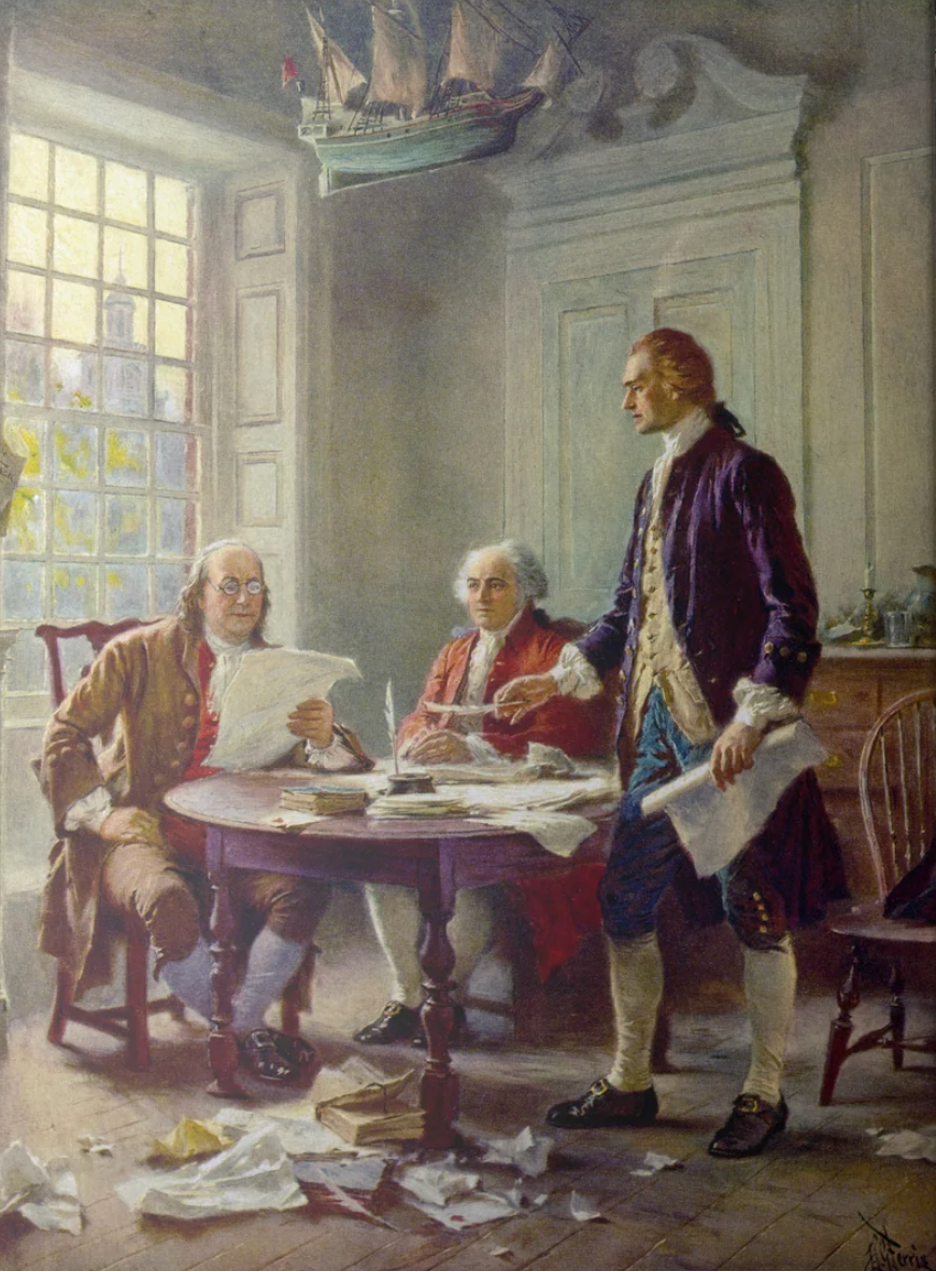
All the founding documents of the United States were written with quills, and all the signatories of the Declaration of Independence signed with a quill, including, famously, John Hancock. It would be nice if the country still had some of those original quills. But none of the quills that the founders used are known to exist today. After being retrimmed a few times, quills were discarded. They were the original disposable writing instrument.

Writing the Declaration of Independence painting by Jean Leon Gerome Ferris
Not until the first quarter of the 19th century did anything challenge quills, and they were imitation quills made of metal. It was harder than it might seem to manufacture such nibs, as they had to be made with exacting precision, attenuating in thickness near the tip, and having a smooth writing point. Their manufacturing was beyond the reach of craftsmen making them one at a time, as had been the practice with quills.
Although it may seem impossibly quaint now, metal dip pens met resistance, especially from master penmen—men who made their living by public performances of their handwriting skills and by teaching penmanship. Some claimed metal dip pens weren’t capable of providing the same flexibility as natural feathers and thus limited the beauty of handwriting. If such metal points came into widespread use, some worried, everyone’s handwriting would look the same!
But eventually, the kind of mechanical precision necessary to make interchangeable parts for the Springfield Rifle, the most common Union infantry weapon, was applied successfully to metal dip pens. By the time of the Civil War, it is likely that most ink put on paper, including the first draft of his Gettysburg Address that Abraham Lincoln wrote partially in ink, was crafted with a metal nib at the end of a wooden holder.
 Esterbrook was one of the major American manufacturers of steel pen nibs, which users inserted into wooden holders and dipped into inkwells.
An inkwell built inside the pen
You can identify handwriting done with dip pens (whether quills or metal) when you see dark words followed by gradually lighter and lighter words, until the writer is obliged to refresh the pen by dipping it into an inkwell. Then the darker-to-lighter progression begins anew.
But the necessity of keeping an inkwell nearby could be troublesome, especially while traveling. Wouldn’t it be nice if pens could carry their own ink, the way pencils carry their own lead? The fountain pen, which started appearing commercially in the US in the 1880s, provided that long-sought solution: a pen that could carry its own ink supply.
The first writing instrument that cost a significant sum, fountain pens were also the first to be the subject of modern advertising, although their time in the sun was limited.
The technical difficulties of inventing a workable and satisfying fountain pen were even more challenging than making metal tips that could imitate the flexibility of feathers. Fountain pens…
1. Had to be able to lay down a steady flow of ink without making blots
2. Couldn’t leak
3. Had to be easy to fill.
In the same decades that Thomas Edison was working on electric light bulbs, George Eastman was producing portable cameras, and Henry Ford was assembling automobiles, pen manufacturers were busy filing patents for fountain pen mechanisms. Several models became commercially viable in the early 20th century and were marketed heavily.
 The Sheaffer pen company’s patent for a fountain pen attachment shows some of the intricacies involved in creating them.
From the Roaring Twenties to the Greatest Generation
The golden age of fountain pens took place between the 1920s to 1940s, when they reached technical, aesthetic, and marketing heights as a major consumer product. During this period, fountain pens from Parker, Waterman, Sheaffer, Esterbrook, and many others, were advertised in full-page consumer magazines alongside White Owl Cigars and Ivory Soap.
General Douglas MacArthur used a Parker fountain pen to sign Japan’s formal surrender documents aboard the USS Missouri on September 2nd, 1945. Immediately after the war, Parker Pen was employing 2,000 people in its factory and offices in Janesville, Wisconsin, second only to the number of employees at the General Motors factory in town.

The reference to “Empire Made” acknowledged Parker’s manufacturing plants in Britain.
A flight risk—and its solution
As much as fountain pens solved a centuries-old problem (a pen that could carry its own ink supply), they solved it only to a point, much the way horse-drawn carriages solved the problem of human transportation only so far. Fountain pens were, and still are, fairly limited in the volume of ink they carry and thus how long they can write without needing a refueling. Plus, they can occasionally get your fingers inky, and maybe even your clothes. And then there is their unfortunate response to flying. That didn’t pose much of a problem when the only people going up in airplanes were barnstormers in biplanes. But once ordinary people began flying in jet airliners in the 1960s, the poor behavior of fountain pens at cruising altitudes became too troublesome to ignore. The mixture of expanding air and liquid ink ruined many a suit and dress. Taking fountain pens on an airplane was like taking horses on the interstate.
The ballpoint pen solved all these problems in a stroke. Ballpoints held their ink in an oil-based paste rather than liquid form, which gave a much longer write. They required no maintenance. And they could sit neglected for months or even years, and still write after taking a swirl or two on a pad of paper. What’s more, with their ball bearing points and fewer components, they were amenable to true mass production.
You might think that at Levenger, since we adore fountain pens, we would be dismissive toward ballpoints. The truth is, we love them both, just as so many people around the world love both classical music and jazz. It’s true that ballpoint pens made fountain pens technically obsolete, but it’s also true that electric light made candles technically obsolete. Yet, who wants to live in a home without both electric light and candles?
End of Part One.
Coming up in Part Two: As one epoch comes to an end, epic shifts in pen practicality come into their own, thanks to the many innovations of ball pens. Plus: I share a personal story that spans early typewriters to the mighty IBM Selectric to the first rudimentary word processors. Watch for an upcoming email that will take you to Part Two.