
Despite the tremendous growth of fountain pens in the first half of the 20th century, these were precisely the same years when writing by hand lost its thousand-year monopoly. Coinciding almost perfectly with the development of fountain pens was a parallel development of a completely different way to put letters on paper: the typewriter.
Part Two: One Epoch Ends, New Ones Begin
This parallel path of innovation was embodied in the career of my grandfather George W. Knock, born in 1897. He began his teaching career as a young penmanship instructor right after World War I. But, with a mind to the future, he also went to school to become a typing instructor, winning competitions for speed and accuracy. I still have his gold lapel pins from contests that the L.C. Smith, Remington, and Underwood typewriter companies sponsored. My grandfather retired in the 1950s as a teacher of business machines (typewriters and adding machines) but still offered his services engrossing the names of high school graduates on their diplomas in his beautiful script.
The typewriter’s takeover of American offices was crowned in one lighthearted way, by Leroy Anderson in his symphonic creation The Typewriter, composed in 1950. After the widespread adoption of typewriters, including portable models, handwriting would never again hold its unchallenged dominion over personal written communication.
By mid-century, people typed their own correspondence. They might use two sheets with a piece of carbon paper in between to have a copy for their records. When finished, they would add their signature at the bottom. Typically, they would roll the envelope into their typewriter to type the address as well.
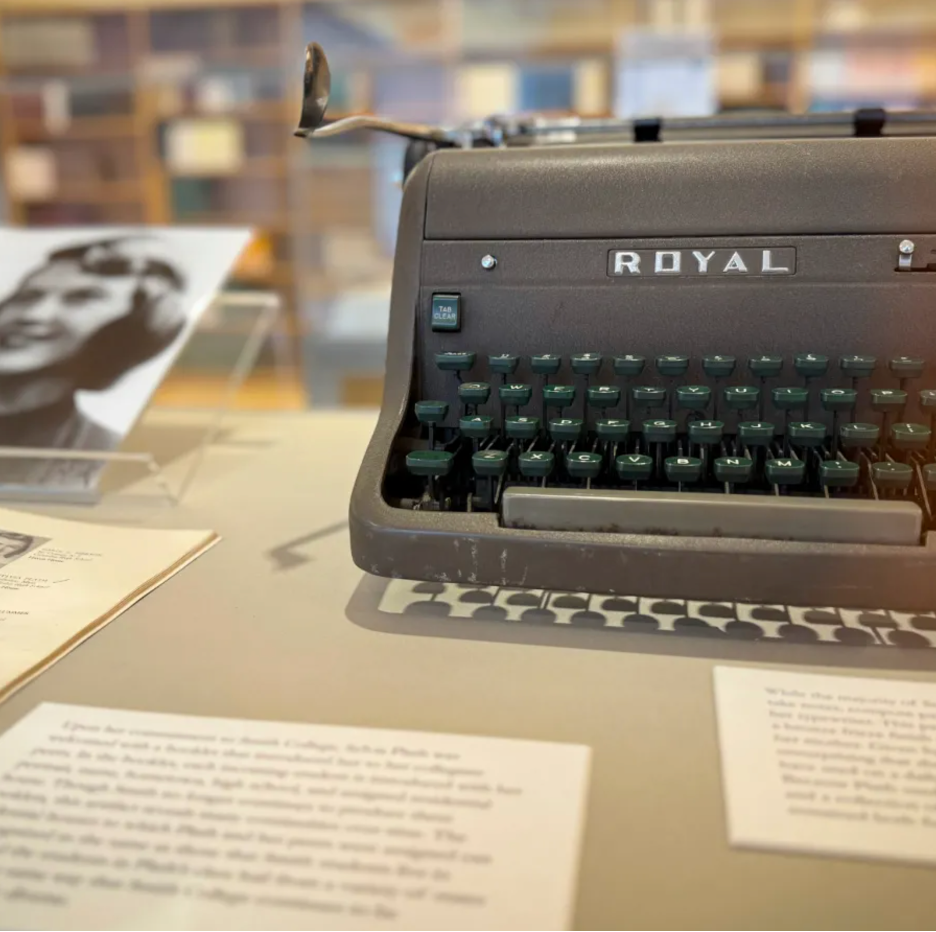
 The typewriter of Sylvia Plath. Smith College.
Evolution continues, creating a long line of obsolescence
Manual typewriters gave way to electric models, most notably the IBM Selectric, introduced in 1961. IBM engineers had replaced the multitude of little hammers with raised letters, which all prior typewriters had, with a spinning ball the size of a golf ball that held all the letters and characters on the outside surface. Somehow, it would spin to just the right orientation before slamming onto the paper as fast as anyone could type. It seemed like magic to me when I first saw one.
I bought a used Selectric in San Diego in 1977 before I drove east to go to grad school. It was the most expensive and useful piece of professional equipment I owned. It was also the heaviest, at almost 40 pounds, but boy, was it solid. I remember how good the keyboard felt, with its deeply scalloped keys and satisfying kerplunks.
So it was a bit sad for me to see the mighty Selectric made obsolete by computerized word processors. I produced my dissertation on something called the IBM Office System/6 word processor, which I used after work hours at my office. It was so valuable that the company I was working for locked it in an inside office with metal mesh panels installed under the ceiling tiles, for fear burglars might drop in. I marveled at how it could show six lines of type on its green screen, allowing me to edit the text with backspace and arrow keys before deciding to print it. What seems laughably quaint now was gee-whiz in 1981, something I would brag about over beers on Friday night with my friends.
Soon dedicated word processors themselves were made obsolete by far more versatile personal computers. One day in 1983, I came to work in the morning to discover an IBM PC sitting on a communal table. The world would never be the same.
As most of us know, boxy PCs were followed quickly by laptops, tablets, and something called texting on smartphones, as well as the voice-to-text feature that we now take for granted.
Handheld writing instruments have continued to evolve, but for more than a century now, all innovation in handheld writing instruments has taken place in the shadow of far faster improvement in alternative means for producing text. Nevertheless, pens, pencils and writing by hand continue to evolve, albeit in a world with far more opportunities for individuals to communicate by alternate means, including not just with text but with photos, videos, voice mails and emoji. But for those unhappy with the devaluing of writing by hand, they may yet be validated by what the latest research shows about traditional methods of hand writing.
Enter the jet-age Jotter
In 1954, Parker made the leap into the jet age by creating its streamlined Parker Jotter, which looked like it might have been a hood ornament on a 1960s Chrysler. Push the top button to get a satisfying double click and see the ball bearing tip extend and retract from the Jotter’s nosecone. In the second half of the 20th century, the Parker Jotter became a design icon, like the Zippo lighter, and its distinctive “tut-tat” clicks entered the American soundscape just as the metallic opening and closing of a Zippo lighter had a couple of decades earlier.

The Jotter is one of the most successful consumer products of all time, in continuous production for
more than 72 years. As I write this, a Jotter is in the shirt pocket of my 96-year-old father-in-law.
In the 1990s, Lori and I toured the Parker Jotter assembly line in France. The line ran 24 hours a day, using just two employees to drop parts into its vibratory feeding bowls spaced along the line. We watched, mesmerized, as the parts shuffled their way up the narrow spiral ledges inside the bowls into the assembly spots, either to find themselves in the proper orientation to feed into the line, or to tumble back into the bowls with thousands of other identical parts to await another trip back up for another try.
When pens again became disposable…
With its Jotter, Parker also set the standard for ballpoint cartridge refills. Called the Parker-style G2 standard, it is the refill that all full-size Levenger ballpoints use, as do many other ballpoint pens made to take refills.
As groundbreaking as the Jotter was, it did not represent the zenith of ballpoint pen manufacturing. The rush toward ever less expensive products led to pens so inexpensive they became, like quills, disposable.
In 1959, the same year that American moviegoers gazed at Marilyn Monroe in Some Like It Hot and Elvis Presley propelled “A Big Hunk O’ Love” to No. 1 on the charts, Bic launched its disposable pen with the slogan, “Writes first time, every time.” With their crystal-clear, hexagonal plastic barrel and signature blue caps, Bic disposable pens quickly took over American offices, homes, and schools.
 Bics were also the ideal pen for young boys in search of mischief. (My confession follows.)
In goofy testimony to their disposability, in the mid-1960s, a fellow paperboy and I would take a break from tossing papers on porches and stop our bikes along some quiet stretch of street to put a match to one of our scuffed-up Bic pens. We did this because we were 11 years old and had discovered that the pens burned readily, emitting a smelly smoke and an unnatural light, made all the more satisfying before the sun was fully up and no adults were around to put a stop to our nonsense.
The only difference I can discern between today’s Bic pens and those of my youth is the hole in the top of the cap, which Bic added in 1991 to help prevent asphyxiation in case of accidental swallowing. (I haven’t yet tested how they burn in the street in dawn’s early light.)
…and carbon paper became carbonless
The utility of ballpoint pens led to a new kind of paper designed specifically for them: the multipart forms, such as checks and those immigration forms we still sometimes get before entering a new country. These are called carbonless copy paper to distinguish them from conventional carbon paper used in typewriters. Ballpoints require a bit more pressure in order to write, which is just what multipart forms need to make their copies legible. My checkbook, itself a vanishing species, still has such multipart paper to make copies of the checks I write—as long as I use a ballpoint pen to write them and press firmly. (Typewriter carbon paper, now long absent from offices, lives on in virtual form in the abbreviation “cc,” for “carbon copy,” in our email options. It’s what’s known as a skeuomorph, an analog holdover that serves as a familiar bridge to our newer digital world.)
Ball pens were not the only handwriting technology making rapid advances in the 1960s. In 1964, Sanford introduced their Sharpie, a fiber tip pen using liquid ink that was well suited to marking on non-paper surfaces. And in 1966, Paper Mate introduced their Flair, also a fiber tip pen, but designed for writing on paper in a bold, bright way. Both brands, and hundreds of other felt-tip pens, continue to be made today and are enjoyed for their fast and bold writing performance.
Ball pens keep rolling with the times
But it was the ballpoint that boldly went where no pen had gone before. Ballpoint refills took a leap into space, literally, with the Fisher Space Pen, which Paul C. Fisher brought out in 1966. The pen was on board for NASA’s Apollo 7 mission in 1968. The technology of these pressurized ballpoint refills made it possible to write in adverse conditions and are still in use today.
Ball pen technology took another important but little noted leap in the 1980s with the introduction of the rollerball and gel ink pens.
Ink chemistry and manufacturing techniques had advanced enough to make it possible to put liquid ink into a tube with a ball at the end rather than a fountain pen nib. The result was a ball pen that would write more fluidly with its liquid ink than a conventional ballpoint with its paste ink, and would lay down a darker, more vivid line with little pressure. Rollerballs succeeded in blending the liquid ink feel of fountain pens with the convenience of ballpoints.
Early rollerball cartridges had a tendency to dry out if not capped, and thus a new cartridge was developed that held enough liquid ink but designed for pens with caps. Capless rollerballs refills soon followed, operating like ballpoint pens with clicks or twists, yet writing like liquid ink rollerballs.
Also in the 1980s, the Japanese invented gel-ink ball pens that could produce darker, smoother lines in a variety of bright colors, although with a shorter write-out. In 1997, the Pilot Pen company debuted its Pilot G2 pen with a retractable click cartridge reminiscent of the Parker Jotter, although Pilot’s G2 was a plastic pen with a rubberized grip and a wide variety of point sizes and colors. Happily the Pilot G2 cartridge, available in thousands of stores, fits in all Levenger rollerball pens.
The reason these breakthroughs were little noted is that the 1980s also saw the world-changing introduction of personal computers. These PCs offered new software called spreadsheets, not to mention word processing programs, which were as much of a leap over typewriters as typewriters were over dip pens. While Time honored the PC on the magazine’s cover as its Machine of the Year in 1983, pen technology continued to advance, just far out of the limelight.
Defying gravitational and digital pulls
Meanwhile, conventional ballpoint refills were not standing still either. The Easy Flow cartridges fit into conventional ballpoint pens while writing like rollerballs. And pressurized anti-gravity refills were developed that could keep your pen writing upside down or on a wet surface up against a wall, much like the Fisher Space Pen.

Levenger offers its own German-made anti-gravity ballpoint refill.
Today, we have more options for writing with our hands than ever before. We can enjoy the biomimicry of fountain pens, their flight from feathered quills resulting in a history of nearly 150 years. With 20th-century ball pen technology, a multitude of options are at our fingertips, from durable, long writing oil-based paste refills, to elegant, free-flowing cartridges in vibrant colors.
While our digital lives dominate the headlines, it’s ironic that there has never been more delightful options for putting ink on paper by hand. And that is fitting, for there has never been more need to escape the distractions of our digital lives and enjoy the peace we seek for creativity and correspondence. That is what paper and pen still bring to our lives.
And while we can run fountain pens on cartridges, we can also dip our fountain pens into ink bottles to write in that time-honored way Leonardo da Vinci and Thomas Jefferson did, harking back to that penna, or quill. In its plural, penna means wing. Writing by hand unspools all kinds of opportunities that help your creativity take wing.
Steve Leveen
Levenger Co-Founder