


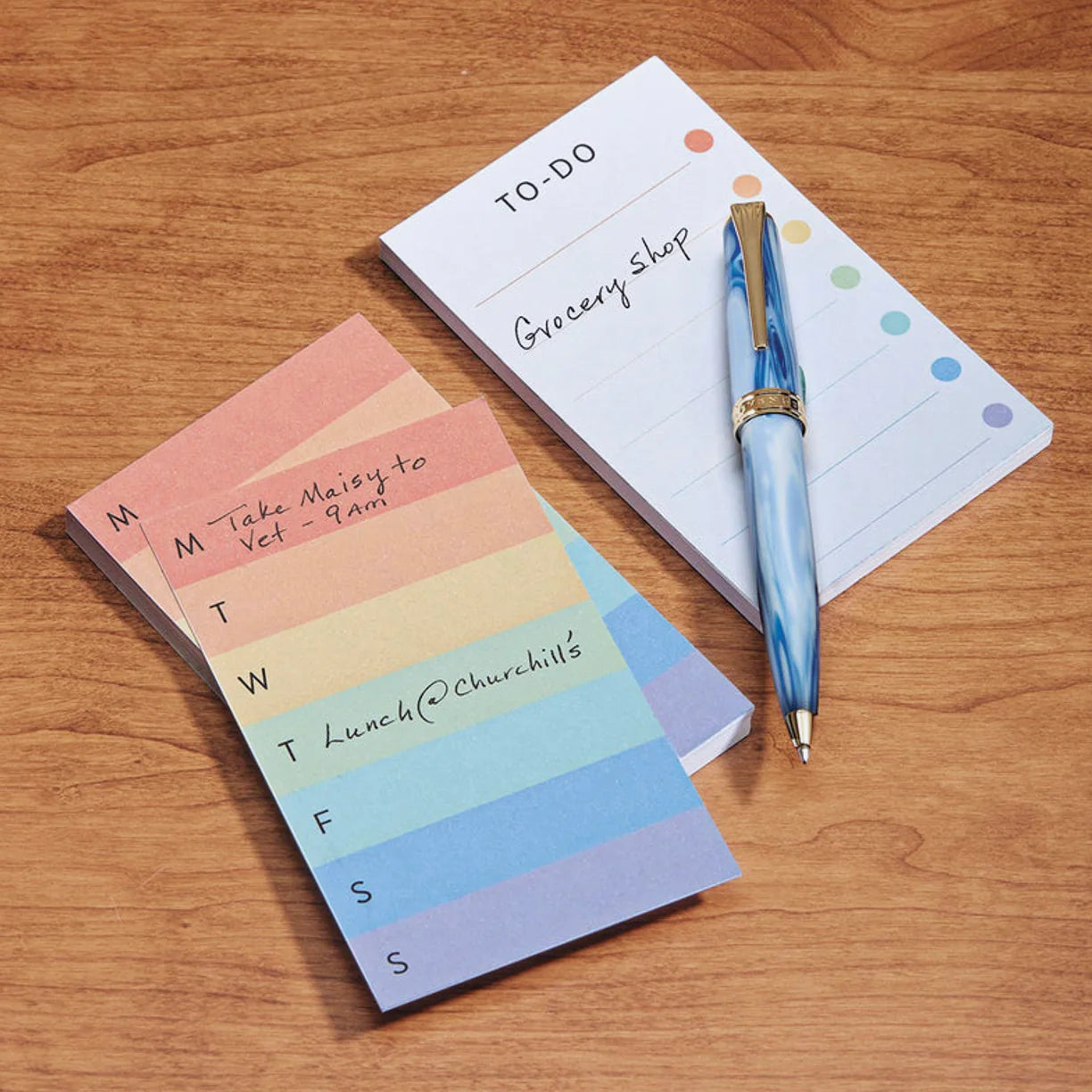
Ten quiet minutes at day’s end can change the way tomorrow feels. This analog shutdown ritual uses a few 3x5 cards and a compact card stand to capture loose ends, commit the next steps, and leave your workspace orderly—at home or in the office. The tools are simple, the cadence is steady, and the payoff is clarity.
Why a short, analog shutdown works
Paper slows thinking just enough to make better decisions. Index cards add a constraint that keeps each note honest and finite. Levenger’s cards are printed on substantial 250‑gsm stock that tolerates fountain pens and markers without fuss, so you can write decisively and file or display cards for reuse.
What you’ll need
- A compact display tray: A small stand keeps today’s critical cards visible and separates “active” from “archived.” The Bamboo Index Card Bleachers has two display rows, rear storage, and a pen ledge; it holds up to four 3x5 cards in view and accommodates 4x6 when needed.
- Fresh 3x5 cards: Choose formats that match how you think—ruled for lists, grid or dot‑grid for structure, or pre‑formatted task layouts. Options below include ruled and dot‑grid sets, checklists, a 1‑3‑5 prioritizer, and tabbed dividers for sorting.
The 10‑minute End‑of‑Day Reset
- Collect (2 minutes): Sweep stray notes from email, chats, and your notebook onto a single capture card. Don’t organize yet—just gather.
- Close loops (3 minutes): For each item: mark it done, delegate it, or convert it to a next step on a dedicated card. If it belongs to a larger project, start a project card and title it clearly.
- Park tomorrow’s focus (2 minutes): Choose one anchor task you’ll start with in the morning and list supporting steps. If you like a structured layout, the 1‑3‑5 Tasker 3x5 Cards help you commit to one major, three medium, and five minor tasks.
- Sort for visibility (2 minutes): Place up to four cards on your stand in this order: Anchor Task, Short List, Waiting/Blocked, and Notes. Store back‑up or completed cards behind the display rows.
- Signal done (1 minute): Tidy your pen, put the remaining stack behind the tray, and leave your desk ready. In U.S. offices, doing this between 4:30–6:00 p.m. keeps late‑day emails from dictating tomorrow’s plan.
Card layouts and when to use them
Match your format to the kind of decisions you’re making most evenings. Here’s a compact comparison to help you choose wisely.
| Card format | Best for | Why it helps | Tradeoff | Levenger option |
|---|---|---|---|---|
| Ruled | Clean lists and quick notes | Lines guide neat, scannable tasks | Less structure for projects | Soft Focus 3x5 Cards |
| Engineer Grid | Sketching workflows and sizing steps | Grid supports mapping and checkboxes | Can feel dense if you prefer open space | Engineer Grid 3x5 Index Cards |
| Checklist | Repeatable shutdown checks | Built‑in boxes make progress visible | Less room for freeform notes | 3x5 To Do Cards |
| Prioritizer | Committing to a realistic daily plan | Encourages one big, few medium, few small | Fixed slots may feel rigid on freeform days | 1‑3‑5 Tasker 3x5 Cards |
| Tabbed dividers | Sorting “tomorrow,” “this week,” “later” | Faster retrieval and batching | Tabs add a bit of bulk | SortSmart Tabbed 3x5 Index Cards |
If you prefer a single card that expands to hold a whole evening’s triage, the fold‑out Think Dream Do Tri‑Analog Planner Cards give you three panels—notes, a checklist, and dot‑grid—for structured planning without opening a notebook.
Setting up your desk tray for flow
Keep the tray front row for “in‑view” cards only. Behind that, store blanks and any completed cards you’ll archive on Friday. The Bamboo Index Card Bleachers includes rear storage for spare cards or a slim marker and a front pen ledge, so the whole system occupies about seven inches of width and stays neat.
- Bamboo Note Card Nook — A smaller footprint than bleachers when the desk is shared or the shutdown is three cards long.
- Nantucket Note Card Box — Where Friday's archived cards go, so the tray starts Monday empty.
Role‑based variations that take 10 minutes or less
- People managers: Keep one “Waiting/Approvals” card visible and review it during your shutdown. Convert anything older than two business days into a nudge you’ll send tomorrow morning.
- Product or project leads: Maintain one card per active workstream. At shutdown, update just the next two steps and file the rest behind tabs like “This Week” and “Later.” Tabbed cards make this quick.
- Designers and analysts: Use a grid card to sketch where you left off so you can resume in seconds. An Engineer Grid card doubles as a mini storyboard.
- Educators and researchers: Keep one “Next class/session” card in front and archive lesson or citation cards weekly.
Weekly maintenance (Fridays in the U.S.)
- Thin the stack: Recycle completed cards. File the few worth keeping by project or month.
- Glance back, then forward: Scan your cards for patterns—recurring blockers or frequent deferrals—then set a realistic Monday anchor task.
- Restock: Keep a small reserve of blank, checklist, and grid cards in the rear slot so Monday starts without rummaging. The tray’s removable divider lets you accommodate 4x6 reference cards if your work calls for them.
Restocking the tray
3 x 5 Card Sampler Pack (set of 75) — the reset only survives if there are blanks in the rear slot on Monday — a sampler covers all three formats at once.
Cost, quality, and value
Levenger’s index cards are engineered for everyday writing—thick, smooth, and durable—so one set serves for months, and the tray is built from solid bamboo for long service. Many items are priced accessibly and the brand frequently offers promotions and Rewards points, making thoughtful tools a cost‑effective upgrade to your routine.
Related reading to extend your routine
Pair this evening ritual with a calm, paper‑first start using Analog Mornings: A 20‑Minute Paper‑First Routine to Set Your Day’s Focus. If you want a weekly reflection to spot trends and keep habits consistent, try Analog Habit Tracking: Dot‑Grid, Index Cards, and Simple Weekly Reviews. For momentum sprints during the day, see Analog Sprinting: 25‑Minute Task Bursts Using To‑Do Pads and Pocket Briefcases, and for a bigger Friday or Sunday reset, explore Weekend Reset: Planning the Week on a Monthly Desk Pad and Compact Circa.
Frequently Asked Questions
Do I need a specific tray, or will any stand work?
Any stable stand that displays a few cards at a readable angle will work. A dedicated option like the Bamboo Index Card Bleachers adds two display rows, rear storage, and a pen ledge in a compact footprint, which keeps the system tidy day after day.
How many cards should I use each evening?
Limit yourself to three or four visible cards: an anchor task, a short list, a waiting/blocked list, and optional notes. Extras can wait in the rear slot until morning so your attention isn’t split.
What if I already use a digital task manager?
Keep your digital system; use cards as your nightly “front end.” Write only what you’ll start tomorrow and what’s currently blocked. The physical constraint helps you choose—a page‑long task list rarely survives contact with the morning.
Can I combine notes and tasks on one card?
Yes—fold‑out cards such as the Think Dream Do Tri‑Analog Planner Cards include panels for notes, a checklist, and a dot‑grid so you can triage, plan, and sketch on a single card.
Thoughtful product picks for a smooth shutdown
- Display and store: Bamboo Index Card Bleachers—two rows for today’s cards, rear storage for blanks, and a pen ledge.
- Prioritize realistically: 1‑3‑5 Tasker 3x5 Cards—a simple structure that enforces sane scope for tomorrow.
- Checklist the shutdown: 3x5 To Do Cards—use one recurring card for “inbox zero, desk clear, calendar glance.”
- Sort workstreams: SortSmart Tabbed 3x5 Index Cards—create “Tomorrow / This Week / Later” lanes you can reshuffle fast.
- Write comfortably: Soft Focus 3x5 Cards—smooth, easy‑on‑the‑eyes stock for nightly notes and summaries.
- Sketch next steps: Engineer Grid 3x5 Index Cards—box out subtasks and quick diagrams.
- Plan on one card: Think Dream Do Tri‑Analog Planner Cards—a compact, fold‑out canvas for evenings when you want notes, tasks, and layout in one place.


