


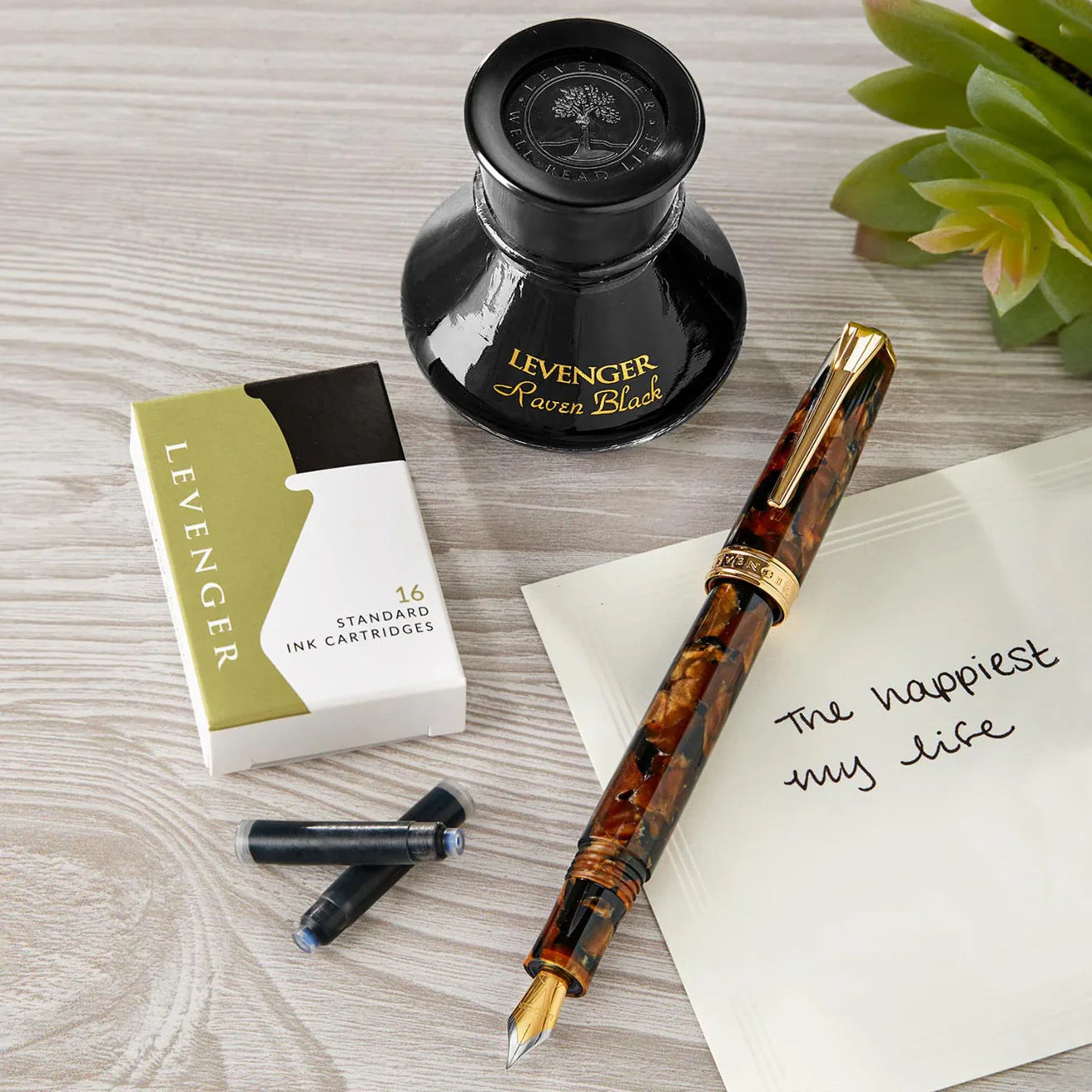
Longevity is the most responsible form of sustainability. Keep a finely made pen in service—refilling, cleaning, and caring for it—and you’ll reduce waste while enjoying a more satisfying writing experience. This guide distills refill choices, maintenance habits, and practical tips so your favorite writer can stay with you for decades.
Refill Strategy, by Pen Type
Fountain pens
Fountain pens endure because they’re refillable. For tidy swaps and portability, choose standard‑international cartridges. For the widest color range and lower cost per fill, use a converter with bottled ink at your desk. If you’re building a simple, reliable setup, a 16‑pack like Levenger Ink Cartridges (set of 16) offers diverse colors in a standard‑international fit and quick‑drying, fade‑resistant formulas. For drying time, water resistance, and sheen behavior across inks, see Ink 101: Cartridges vs. Bottled, Drying Time, Sheen, and Water Resistance. If you mix brands, match standard‑international dimensions and verify the fit before inking; our overview in Refills & Converters: Getting the Most from Your Levenger and Partner Brands explains how.
Rollerballs
Rollerballs deliver liquid‑ink smoothness with mess‑free swaps. For broad compatibility across many Levenger bodies, the German‑engineered Levenger Safety Ceramic Rollerball Refills (set of 2) are a dependable everyday choice, available in practical tip sizes. Exploring line widths or colors for color‑coding? The Levenger Rollerball Ink Refill Sampler (set of 6) makes side‑by‑side comparison easy. If you’re still weighing formats by feel and upkeep, see Choosing Your Everyday Writer: Ballpoint vs. Rollerball vs. Fountain.
Ballpoints
Ballpoint refills emphasize write‑out length and reliable starts. They’re practical for forms, mixed‑paper notebooks, and quick signatures where you may not cap immediately. For long service between swaps, consider a value pack such as Levenger Ballpoint Pen Refills (set of 6). If grip comfort is a priority, match body weight and diameter to your hand with Ergonomics & Balance: Matching Pen Weight and Diameter to Your Grip.
Fiber‑tip (felt) and capless roller formats
For sketch‑notes and bold annotations, fiber‑tip refills offer tactile feedback and saturated lines; keep a pair like Levenger Fiber Tip Refills (set of 2) on hand because tips can dry faster if left uncapped. Prefer retractable convenience with liquid‑ink feel? Choose refills designed for capless mechanisms, such as Levenger Capless Rollerball Refills (set of 2), formulated to resist drying in the cartridge while drying quickly on the page. For compatibility nuances across formats, see Refills & Converters.
- Levenger Ink Cartridges (set of 16) — A 16-pack of standard‑international cartridges gives tidy portability, lots of color choices, and quick swaps for fountain pens.
- Levenger Safety Ceramic Rollerball Refills (set of 2) — Two ceramic rollerball refills for Levenger bodies offer a reliable, portable liquid‑ink option when you want smooth lines on the go.
- Levenger Rollerball Ink Refill Sampler (set of 6) — A six‑color rollerball refill sampler lets you test multiple ink shades and tip behaviors before committing to bottled ink.
- Levenger Classic Ballpoint Pen Refills (set of 6) — Classic ballpoint refills in a six‑pack provide low‑maintenance, long‑lasting ink for travel and everyday carry.
- Levenger Fiber Tip Refills (set of 2) — Fiber‑tip refills give a bold, consistent line for quick notes and headings when you need high contrast in portable form.
- Levenger Capless Rollerball Pen Refills (set of 2) — I want the refill option for my fountain pen that balances portability, color choice, and low cost per fill.
Decision Matrix: Which Refill Format Fits Your Priorities?
Use this compact matrix to align your refill with how—and where—you write.
| Format | Convenience | Ongoing Cost | Care Level | Standout Advantage |
|---|---|---|---|---|
| Fountain Cartridge | Very high | Moderate | Low–Moderate | Clean swaps; portable color choice |
| Fountain Converter + Bottled | Moderate | Low | Moderate | Lowest cost per fill; widest ink variety |
| Rollerball Refill | Very high | Moderate | Low | Liquid‑ink smoothness; quick replace |
| Ballpoint Refill | Very high | Low–Moderate | Very low | Long write‑out; works on many papers |
| Fiber‑Tip Refill | High | Moderate | Low | Expressive, saturated marks |
| Capless Roller Refill | Very high | Moderate | Low | Retractable convenience; liquid‑ink feel |
Still deciding between formats? Our Nib Selector explains how tip sizes affect feel and drying, and Paper Compatibility helps you match inks to paper for cleaner pages and fewer smudges.
Care Rituals That Add Years
Think of maintenance as small, repeatable habits. They take minutes—and they dramatically extend service life.
- Weekly: Wipe the nib or tip with a soft, lint‑free cloth. Check caps and threads for a firm, aligned close.
- Monthly: If a fountain pen is in regular rotation, flush with cool water until clear, then air‑dry nib‑down. For rollerballs, verify the cap seal; replace a tired refill before it scratches paper. A step‑by‑step is in Maintenance Rituals: Cleaning, Flushing, and Safe Storage.
- Quarterly: Inspect seals, converters, and sections. Replace low‑cost consumables proactively—converters and fiber tips are inexpensive compared to pen bodies. For display and organization that also protect finishes, see Presentation Matters: Cases, Stands, and Desk Display Ideas.
Replace the cheap part, not the pen
K2 Fountain Pen Piston Converter — a converter costs a fraction of a pen body and is the component that actually wears — swapping one is the cheapest maintenance there is.
Storage, Transport, and Climate Tips
- Cap and stow horizontally for travel; nib‑up for storage. This limits flooding in transit and prevents dry‑out between sessions. Frequent flyers can prep with Traveling with Pens: Flying, Leaks, and Everyday Carry.
- Mind temperature swings. In hot cars or on summer flights in the United States, pressure changes can force liquid ink out. Pack pens nib‑up in a sleeve and empty fountain pens before long flights if you won’t write en route.
- Paper matters. Smooth, fountain‑friendly papers reduce fiber buildup on nibs and tips. For pairing notes, visit Paper Compatibility: Which Levenger Papers Love Fountain Pens.
- Fit and comfort affect fatigue. If long sessions leave fingers cramped, explore body diameter and balance in Ergonomics & Balance.
- Canvas Pen Pouch — Keeps nibs apart and off keys for the commute, at the price of a couple of refills.
- Leather Pen Folio — Holds a rotation nib-up between uses, which is most of what long service asks for.
Simple Troubleshooting Before You Replace a Refill
- Hard starts (fountain): Flush with cool water; try a fresh cartridge; verify cap seal. If issues persist, review Troubleshooting Flow: Skips, Hard Starts, and Scratchiness.
- Skipping (rollerball): Ensure the cap seals fully; replace with a fresh unit like Levenger Rollerball Refills (set of 2) to check whether the symptom follows the refill or the pen.
- Scratchy feel or too‑thin lines: Consider a different line width. The Nib Selector explains how tip sizes change feedback and drying.
- Ink smudging (left‑handed writers): Try faster‑drying inks, finer tips, or slightly more absorbent paper; see Left‑Handed Writing Tips: Smudge Control and Line Choice.
- Levenger Rollerball Refills, Extra-Fine (set of 2) — Extra‑fine Levenger rollerball refills are the simple swap to check whether skipping follows the refill or the pen.
- Waterman Rollerball Pen Refill — A Waterman rollerball refill is a reliable OEM option to replace a suspect refill and diagnose skipping or flow issues.
- Lamy Rollerball M63 Refill — Lamy M63 rollerball refills are a common, easy replacement to test rollerball skipping and restore smooth starts.
Stock Smart: Refill Kits That Cover Everyday Needs
- Office and legal pads: Medium rollerball refills balance smoothness with high readability; Levenger Safety Ceramic Rollerball Refills are a straightforward pick for many Levenger bodies.
- Meeting notes and margins: Keep high‑contrast colors on hand with the Rollerball Ink Refill Sampler to color‑code topics without swapping pens.
- Annotation and sketch‑notes: A bold fiber tip creates clear headings and callouts—stock Fiber Tip Refills alongside your note‑taking pen.
- Everyday reliability with long intervals between swaps: Choose a value pack such as Levenger Ballpoint Refills (set of 6) for long write‑outs on varied paper.
- Gifts with long service life: A well‑built rollerball such as the True Writer Classic Café Mocha Pen pairs with standard Levenger refills, making upkeep simple for new owners. For style pairing ideas, see Gifts That Write: Matching Personalities to Pen Styles and Finishes and the True Writer Buyer’s Guide.
- Starter bundles: If you’re equipping someone for both meetings and signatures, a duo like the Faber‑Castell Poly Fountain Pen and Ballpoint Gift Set covers fine correspondence and everyday forms with refillable formats.
- Retractable convenience: If you reach for a pen every few minutes, keep Capless Rollerball Refills on hand so you can maintain a quick‑draw workflow without sacrificing liquid‑ink feel.
- Desk and doodle pairing: A hybrid set like the Retro 51 Tornado Vintage Dr. Gray Rollerball & Pencil Set lets you annotate in ink and sketch in pencil—both formats are easily replenished.
- True Writer Classic Cafe Mocha Pen — A versatile True Writer pen that pairs with common Levenger refills for a ready meeting‑ready writing kit.
- Faber-Castell Poly Fountain Pen and Ballpoint Gift Set — A fountain and ballpoint gift set provides both ink types so you can stock office needs across pen styles.
- Retro 51 Tornado Vintage Metalsmith Dr. Gray Rollerball & Pencil Set — A retro rollerball and pencil combo gives a durable everyday writing set suited for meetings and quick notes.
Value, Deals, and Long‑Term Cost of Ownership
Sustainability includes total cost over time. Refillable pens spread the investment across years of use. Levenger’s refills and multi‑packs are often priced to make everyday writing economical, and periodic promotions in the U.S. can provide extra value when you plan ahead. Levenger Rewards members earn points toward discounts, and points currently expire 6 months after the purchase date; it’s a gentle nudge to restock on your schedule. You’ll also see seasonal double‑points events and other perks announced on the site. Some Levenger pens use higher‑grade materials and craftsmanship, representing a larger initial outlay, yet they’re designed for inexpensive refilling and serviceable parts—practical if you write daily and prefer to buy once, maintain well, and keep using what you love.
Serviceable beats disposable
True Writer Select Fountain Pen Nib — a replacement nib unit restores the writing end of a True Writer without replacing the pen — the practical case for buying once.
- True Writer Select Fountain Pen Nib — A replaceable True Writer nib lets you maintain performance and avoid replacing the whole pen for long‑term value.
- Lamy Multisystem Ballpoint Refill (set of 2) — Lamy multisystem ballpoint refills are compact multi‑packs that minimize cost and waste for everyday ballpoint use.
- Lamy .5mm HB Lead Refills (set of 12) — A 12‑pack of .5mm HB leads supplies long‑running pencil refills that reduce replacement frequency and waste.
Regional Notes for U.S. Writers
- Arid climates (e.g., Southwest): Evaporation is faster. Cap promptly and prefer cartridges/converters with reliable seals. Fiber‑tips may dry sooner—store capped and carry a spare.
- Cold winters (e.g., Upper Midwest, Northeast): Thickened inks can start hard. Warm the pen in your hands for a minute before writing; consider a slightly wetter refill or broader nib/tip for winter months.
- Coastal humidity (e.g., Southeast): Increased moisture can slow ink drying. Favor finer tips or fast‑drying inks and give pages an extra beat before closing a notebook.
- Frequent flyers: Empty fountain pens before long flights if you won’t write en route, or carry nib‑up in a sleeve. See Traveling with Pens for pre‑flight checks.
Build Skill and Joy Over Time
One of the pleasures of keeping a pen for years is growing your technique. If you’re curious about expressive lettering or crisp italic headers, explore Calligraphy & Special Nibs. If you’re assembling a focused, versatile lineup, Starter to Collector: Building a Capsule Pen Collection offers a thoughtful progression from one trusted daily writer to a small, purposeful set.
Frequently Asked Questions
How do I estimate the true cost of refills over a year?
Start with your average pages per week, then map to refill formats: ballpoints offer long write‑outs and fewer swaps, rollerballs trade a bit of longevity for liquid‑ink smoothness, and fountain pens with bottled ink provide the lowest cost per fill but ask for occasional flushing. Our matrix above and Choosing Your Everyday Writer can help you balance cost, feel, and care.
Which refill should I keep as a backup in my bag?
For reliability on varied paper, a ballpoint is a safe backup—consider a spare from a pack like Levenger Ballpoint Pen Refills. If you prefer liquid‑ink feel, carry a capped rollerball and store it tip‑up to reduce the risk of flooding during travel.
How often should I flush a fountain pen?
With daily use, a light water flush about once a month keeps flow consistent. If you change colors or notice hard starts, flush sooner. A detailed cadence appears in Maintenance Rituals.
What if my pen skips after months of perfect performance?
Rule out simple variables first: confirm the cap is sealing, test a fresh refill (such as Levenger Safety Ceramic Rollerball Refills), and try smoother, pen‑friendly paper. If the issue persists, see Troubleshooting Flow.
Next Steps
If you’re choosing your everyday writer, compare formats in Choosing Your Everyday Writer, then fine‑tune line feel with the Nib Selector. To keep your tools looking their best, adopt a light routine from Maintenance Rituals and store them thoughtfully—ideas in Presentation Matters. Sustainable writing is a habit: choose well, maintain simply, and enjoy the pages you’ll fill over the years.


