


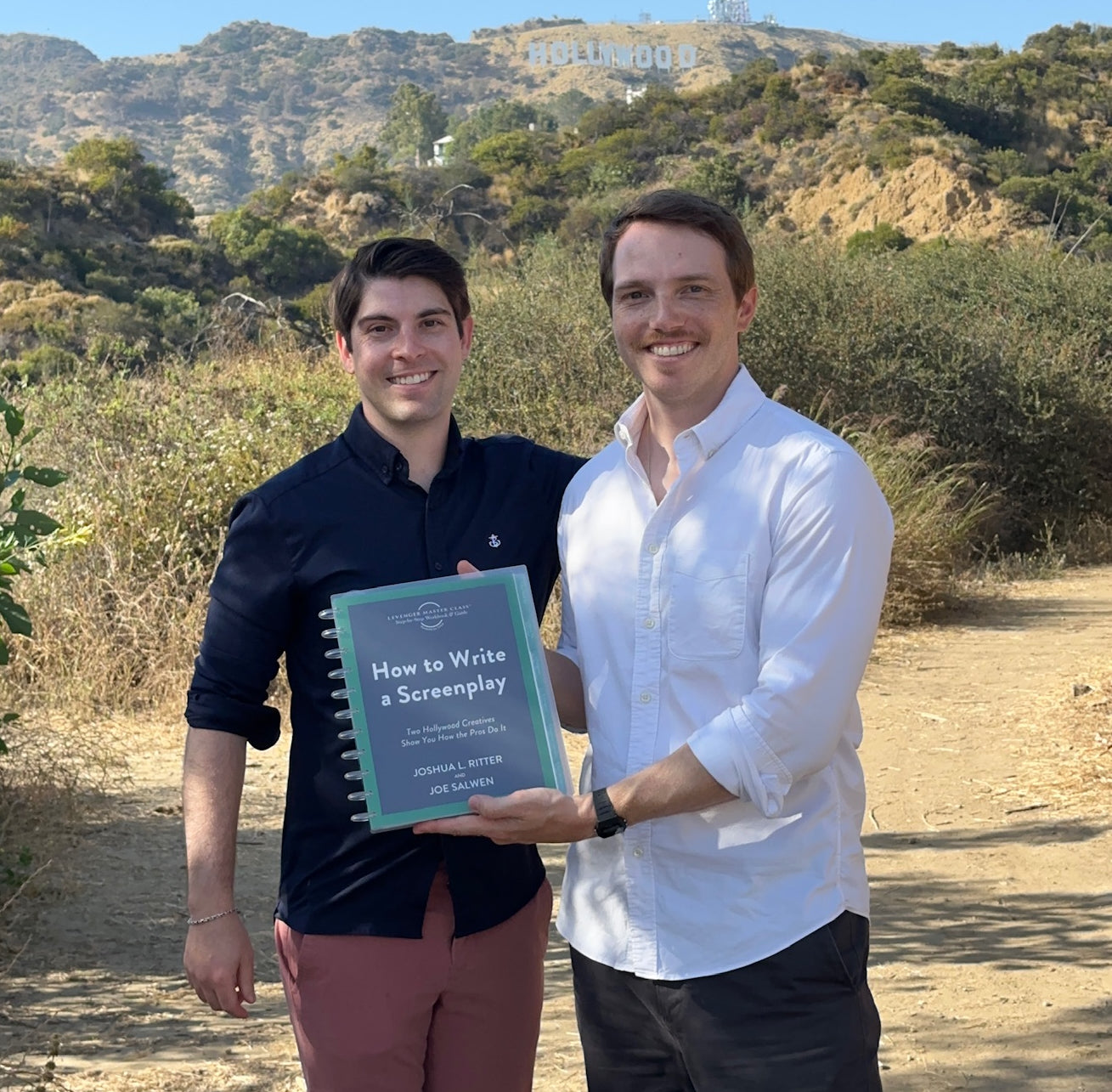
Chasing a dream in the rough-and-tumble of big-time show business takes passion, guts, creativity and skill. Through their adventures in the screen trade—including years of experience working on both the agency and production sides of the business—Joshua L. Ritter and Joe Salwen have enjoyed a rare birds-eye perspective on the mysterious medium of screenwriting. Together, they’ve developed an ingenious step-by-step method for bringing a screen story to life, which they now share in their new Levenger Master Class™ workbook How to Write a Screenplay.
Friends, collaborators and business partners for nearly a decade, Ritter and Salwen are truly in sync with their material and their message, both experts in the art of the story for motion pictures and television—passionate, articulate, analytic and process-oriented. Indeed, their exuberance and synergy recall the young Matt Damon and Ben Affleck as they first made a splash in the business 30+ years ago with their Oscar-winning debut script for Good Will Hunting.

Joshua L. Ritter

Joe Salwen
A Creative Partnership
“Josh is the creative one, full of imaginative ideas, a visionary,” says Joe, while Josh describes Joe as “practical, analytical, production-oriented…getting ideas down from the clouds and into the real world.”
They knew they had to write this book together.
“I went to school for screenwriting and learned that a screenwriter was NOT what I wanted to be,” Joe says. “I realized I had more of an affinity for the development and production side. Josh is the born writer.”
“I do have a passion for writing, for scene work, dialogue, creating complications and conflict,” Josh says. “That’s one secret we reveal in the book—conflict is king.”
Ritter and Salwen met at one of Hollywood’s top agencies, where Joe was an assistant and Josh had just started in the mailroom (which also happens to have been David Geffen’s first show business job).
“Almost everyone in the film industry starts at an agency,” Joe explains. “It’s a baptism by fire, almost like grad school, a crash course in the way the movie business really works. It’s very intense, a stress test, but you learn by osmosis, taking calls, scheduling meetings and gathering and disseminating information. In the movie business, information is everything…what you know and who you know. Then you connect the dots.”
“I didn’t like Joe at first,” reveals Josh. “I thought he was very serious and standoffish. But when I finally became an assistant, too, we were seated next to each other and it forced us to start interacting. Then we found out we have a similar sense of humor and the same cultural references; we actually had a lot in common.”
The pair began playing a game called Loglines du Jour, where they would satirize the elevator pitches and loglines for stories going around the industry. (What are loglines and elevator pitches, you might ask? Get their workbook and you’ll find out!)
Soon, Joe went on from the agency to work for a major production company, and as luck would have it, Josh soon got a job at the same company and they began to work closely together. So their partnership was meant to be—it was kismet.
“We turned out to have excellent work chemistry,” says Joe. “Our perspectives and skill sets really mesh. We instinctively know each others’ strengths and weaknesses.”
“Today, we finish each others’ sentences like other people finish each others’ sandwiches,” Josh jokes.

Behind the Scenes in the Movie Biz
What Joshua Ritter and Joe Salwen have learned from years of experience working in film production—story structure and character development, taking an idea from concept to finished script—they now bring to aspiring screenwriters in their How to Write a Screenplay Master Class workbook.
Working in development and production requires the constant reading and evaluating of material—scripts, books, ideas—for possible production, and everyone on the staff of a production company participates in ‘weekend read’ meeting where they share information and decide if a project moves forward and who will take charge of it.

“We would read five to seven scripts a week, plus a book, and have to report back on them in the weekend read meeting,” Josh recalls. “You have to create coverage—like a summary or book report—on each piece. For anything you read or want to develop, you have to distill the story to its essence so it can be instantly communicated—that’s the pitch.”
This is how Salwen and Ritter became experts in all the elements of the craft of screenwriting. Once they learned the structure of how a movie needs to unfold, and the elements that are necessary for it to succeed, they realized that the script development process could work like a well-oiled machine. There is a formula to this type of storytelling, and it’s all laid out in their workbook. How to Write a Screenplay is the perfect guide for anyone writing an original screenplay.

Because the journey from concept to finished film can take years, writing a screenplay requires a major commitment—you must have a ‘North Star” guiding your way forward, because you’ll experience a lot of setbacks and seemingly unsolvable problems along the way. But have no fear, Josh and Joe know just what it takes to help writers work through their blocks.
Creativity: What AI Can Never Deliver
The AI revolution is affecting every industry, and Hollywood is no exception, but the authors believe that creativity and originality cannot be created by artificial intelligence, which can only amalgamate and regurgitate information but never create anything entirely new or innovative. It cannot give birth to an original thought—but you can.
Their workbook is an anti-AI statement, in a way, according to Josh. “Our book offers a vacation from screen time and requires you to get out your pencil or pen and start writing and fleshing out your idea. It requires critical thinking and complete engagement with your story. A machine can’t take the place of the human imagination at work. The best AI can do is aim for the middle—a real writer will always strive for the best.”
“Storytelling is an individual and personal journey,” Joe agrees. “AI is not a source of inspiration. Honesty, truth and the human experience is something AI can never deliver.”
Your Story—Your Dream
“You have limitless creativity at your disposal by using the screenplay as your medium of storytelling,” Joe says. “Create something from nothing—and then decide you can do even better, because great writing is always rewriting.”
“Only 10% of people who start writing a screenplay ever finish it,” Josh adds. “Our book helps you get started and takes you right to the finish line—and it’s a companion through every step of the storytelling journey. The process is like putting together the pieces of a puzzle—and we provide the keys to unlock the puzzle for you.”
The Master Class Workbook gives writers a safe space to explore and express themselves. “It’s very personal desire, to write a screenplay,” Joe says. “It’s a big dream that most are afraid to admit to anyone. They keep it a secret for fear of being ‘cringe’—‘Oh, you think you can do that? Who do you think you are?’”
“If you’ve ever wanted to write a screenplay, this Master Class is for you. We’ll help you delve deep into your imagination and then stretch it as you bring your story to life on the page. We will be with you each step of the way on your creative journey.”
***

About the Authors
Joshua L. Ritter grew up in Boulder, Colorado, as the youngest of four siblings. He double-majored at the University of Arizona, earning a BA in film and television and a BS in speech, language, and hearing sciences. Driven by his love of science fiction, Joshua also completed a minor in astronomy, which often plays a major role in science fiction. It’s a passion that still inspires him today—just ask his dog, Mars! Joshua has a proven track record as both an entertainment executive and a screenwriter. He was a core part of the development team behind three Netflix films that hit No.1 globally: Outside the Wire, The Weekend Away, and End of the Road. He has extensive production experience on set, advancing from his first job on Big Brother to working on big-budget movies like Night Teeth. As a creative executive at Sustainable Imagination, Joshua developed projects under the company’s first-look deal with Lionsgate. During his tenure, he oversaw the Peacock film If You Were the Last, and helped package Miramax’s Scandalous! starring Sydney Sweeney. Joshua’s screenwriting career kicked off after he placed in several screenplay competitions, including the Austin Film Festival and the Hollywood Screenplay Contest. In 2024, Joshua optioned a screenplay that he co-wrote for Dimension Studio/DNEG.
Joe Salwen is a creative, producer, and executive who has been credited on titles ranging from Academy Award-winning theatrical releases to commercially successful streaming hits on Netflix and Amazon Prime Video. He graduated from Northwestern University with a BA in screenwriting. Joe has developed and produced films across genres, ranging from sports dramas to creature features, true crime, dramedies, sci-fi, and action thrillers. His recent credits include Brady Corbet’s three-time Oscar-winning epic The Brutalist, starring Adrien Brody, Felicity Jones, and Guy Pearce; and Amazon’s My Fault: London, a breakout hit that led to the commissioning of two sequels. Prior to that, Joe was a production executive at the management and production company 42, where he oversaw the British Independent Film Award winner The Silent Twins in addition to other titles. Joe splits his time between LA and London, where he lives with his Pomeranian, Arlo.